## Why

The TUI automatically canceled MCP user verification requests, preventing users from completing verification and approving them.

## What changed

- Show verification prompts for active and inactive threads, with actions to verify and approve or cancel.
- Run approved verification through the local app-server's `userVerification/verify` RPC and return the proof to the original request. Cancel on failure and show a warning in the requesting thread; remote workspaces remain unsupported.
- Deduplicate prompts, preserve foreground streaming when another thread requests verification, and surface queued prompts when returning from a side conversation.
- Cancel verification when its thread is discarded and ignore stale results after cancellation.

## Testing

Add RPC, routing, and snapshot tests covering successful verification, unsupported binaries and remote workspaces, cancellation and late proofs, prompt replay, side conversation switching, and foreground stream preservation.

GitOrigin-RevId: 2ae12f47c443e17de25f4ec033f6078ac28b1e03
## What changed

- Track verification parameters and attempt IDs with cancellation tokens so callers can reject stale results after cancellation, server resolution, or reconnect.
- Add `ResolveUserVerification` to send acceptance proofs or cancellation through MCP elicitation responses, omit proofs from session recordings, and remove resolved prompts from thread replay.
- Add typed verification error messages with safe fallbacks that omit raw provider diagnostics.

## Testing

Add unit coverage for attempt invalidation, duplicate attempt prevention, proof serialization, resolved prompt replay, and safe error messages.

GitOrigin-RevId: 3466c9a83fe5f512a861fec062bef10dcd3025c8
## Why

Permission requests can originate in an environment whose path convention differs from the Codex host. Requiring the request working directory to be host-native prevents those requests from reaching interactive approval.

## What changed

- Carry the request `cwd` as a `LegacyAppPathString` through core events and the app-server protocol so the target environment's native representation is preserved.
- Convert the preserved value back to a `PathUri` when materializing permission grants.
- Regenerate the JSON and TypeScript protocol schemas for the updated `cwd` type.

## Testing

- Exercise the app-server permission request round trip with a target-native working directory across host path conventions.
- Verify remote permission requests retain their environment working directory and granted access still unblocks later execution.

GitOrigin-RevId: 97dc9707d9048883d20bab1b69c93871039f3188
## What changed

- Add a `writeStdin` Guardian action carrying the approval, process, input, and working-directory details.
- Distinguish `command` and `writeStdin` execution approval requests while defaulting missing kinds to `command` for compatibility with older events.
- Render terminal-input review progress, denials, timeouts, and retry actions in the TUI, and record the action separately in analytics.
- Keep terminal-input reviews as child approvals so they do not change the parent command item's lifecycle or reconstructed history.

## Testing

- Cover Guardian serialization, app-server protocol conversion, command history reconstruction, analytics classification, and TUI review flows for terminal input.

GitOrigin-RevId: b083d5e2963bdd23b928644ec03c7eb68ebf2950
## Why

The TUI rejected app-server dynamic tool calls as unsupported, so agents could
not inspect or manage other Codex tasks through a TUI session.

## What changed

- Add the `codex_tui` tool namespace for listing, reading, waiting on, creating,
  forking, messaging, renaming, archiving, and restoring tasks.
- Handle tool calls through existing app-server thread operations, with bounded
  inputs and responses and cleanup when calls complete or the TUI disconnects.
- Route delegation tools through an authenticated local MCP server with explicit
  approval prompts, while respecting configured and managed MCP policies.
- Fall back to starting threads without dynamic tools when connected to an older
  app server that does not support them.

## Testing

Add coverage for tool schemas and response bounds, task lifecycle operations,
approval-gated MCP transport, namespace dispatch, cancellation, and legacy
app-server fallback behavior.

GitOrigin-RevId: c782c11f0a3edceb3fa6909a4b92d6ce01a6eed3
## Why

Approval and item IDs can collide across concurrent threads. Tracking pending app-server approvals by ID alone can therefore resolve, submit, or dismiss a request from the wrong thread.

## What changed

- Key command execution, file change, and permissions approvals by both thread ID and approval ID.
- Route approval responses through the originating thread and require the thread to match when processing resolution notifications or dismissing approval prompts.
- Canonicalize parseable thread IDs so equivalent UUID representations still match.

## Testing

- Cover colliding approval IDs across threads, mismatched resolution notifications, prompt dismissal, and response routing for primary and background threads.

GitOrigin-RevId: c2d899a1e4b6a6413c78a0595a5311f5fabb9815
## What changed

- Let users start tasks, open root sessions, rename tasks, and stop active work directly from the agents overview.
- Show details for the selected task on wide terminals and limit the overview to root sessions while still reflecting background activity.
- Preserve draft input and pending server requests when switching sessions so running roots and their subagents can continue in the background.
- Apply the selected project's working directory when dispatching from project grouping, including remote workspaces.

## Testing

- Expand overview rendering and interaction coverage for root filtering, dispatch, search, selection, renaming, and responsive input.
- Cover switching away from roots with running subagents and retaining background server requests.

GitOrigin-RevId: b7b0d33b7ecc077498efb756a0ad2fd425158b17
## Why

Clients need to know whether a `request_user_input` request must wait for an
explicit response or may auto-resolve. Using `autoResolutionMs` as that signal
conflated the blocking decision with timeout policy.

## What changed

- Add required `isBlocking` fields to user input protocol and app-server
  request payloads. Plan-mode requests are blocking, while requests from other
  enabled modes are non-blocking.
- Drive the TUI's auto-resolution behavior from `isBlocking` and remove
  `autoResolutionMs` from the model-facing tool schema.
- Deprecate `autoResolutionMs` while retaining it for compatibility, and treat
  legacy payloads without `isBlocking` as blocking.

## Testing

- Cover mode-derived blocking behavior, legacy deserialization, app-server
  forwarding, delegated requests, and TUI auto-resolution.

GitOrigin-RevId: 29aade657ef743065ec264376ba567a9b353d7d7
## What

Server should request:

```
{
  "id": 42,
  "method": "currentTime/read",
  "params": {
    "threadId": "11111111-1111-1111-1111-aaaaafdc2c11"
  }
}
```

Client should respond with something like:

```rust
{
  "id": 42,
  "result": {
    "currentTimeAt": 1781717655
  }
}
```

## Why

Sessions configured with `clock_source = "external"` need a
thread-specific external time source before inference. The system clock
remains the default production provider.

## Validation

- `cargo test -p codex-app-server-protocol`
- `cargo test -p codex-app-server --test all
current_time_read_round_trip_adds_reminder_to_model_input`
- `cargo test -p codex-app-server
first_attestation_capable_connection_for_thread_only_uses_thread_subscribers`
- `cargo test -p codex-analytics`
- `just fix -p codex-app-server-protocol`
- `just fix -p codex-app-server`

Stacked on #28824.
## Why

Command approval cache keys included the command and working directory,
but not the execution environment. An approval for `/workspace` locally
could therefore be reused for the same command and path on an executor.

## What changed

- Include the selected environment ID in shell and unified-exec approval
cache keys.
- Carry that ID through the normal command approval request so clients
can show which environment is being approved.
- Expose the environment through app-server as a required nullable
`environmentId` and show it in the inline TUI approval prompt.
- Keep older recorded approval events compatible when the environment is
absent.

For example, `echo ok` in local `/workspace` and `echo ok` in executor
`/workspace` now produce different approval keys and separate prompts.

## Scope

This PR does not change network approvals, Guardian review actions, MCP
elicitation, full-screen TUI rendering, or environment-ID validation.
Remote `shell_command` execution itself remains in #28722; this PR only
makes its approval key environment-aware.
## Why

Clients running an app-server on one OS and an exec-server on another OS
need to be able to pass sandbox config to app-server that refers to
resources on the executor's foreign OS.

## What

`AbsolutePathBuf` can't represent these paths and we don't want users to
be exposed to `PathUri` yet, so this moves the public app-server API to
be expressed in terms of `ApiPathString`.

Stacked on #28165.

- change app-server v2 filesystem permission paths, including legacy
read/write roots, to `ApiPathString`
- localize API paths through `PathUri` when converting into the current
native core permission types
- make path-bearing permission conversions fallible and surface
localization failures instead of silently treating malformed grants as
ordinary denials
- propagate conversion failures through app-server and TUI approval
handling
- regenerate the app-server JSON and TypeScript schemas
- leave migration TODOs on native-path conversions so they can be
removed once core permission paths use `PathUri`
## Why

`request_user_input` is moving beyond its original plan-mode-only
workflow, and future default/goal-mode usage needs a way for the model
to ask helpful but non-blocking questions without forcing the turn to
wait forever. This PR adds an explicit `autoResolutionMs` contract so a
later client/runtime change can auto-resolve unanswered prompts after a
bounded window while leaving truly blocking questions unchanged.

This is contract plumbing only; it does not implement the client-side
timer or auto-selection behavior, and the model-facing description
treats the field as reserved unless the current runtime explicitly
supports auto-resolution.

## What Changed

- Added optional `autoResolutionMs` to the model-facing
`request_user_input` args and core `RequestUserInputEvent`.
- Added model-facing schema text for `autoResolutionMs` while marking it
reserved for runtimes that explicitly support auto-resolution.
- Bounds `autoResolutionMs` to `60_000..=240_000` ms during argument
normalization by clamping out-of-range model-provided values.
- Propagated the field through app-server v2
`ToolRequestUserInputParams`, app-server request forwarding, generated
TypeScript, and JSON schema fixtures.
- Updated app-server, core, protocol, and TUI call sites/tests so
omitted values preserve existing `None`/`null` behavior and coverage
verifies a `Some(60_000)` round trip.

## Verification

- `just test -p codex-app-server-protocol`
- `just test -p codex-core request_user_input`
- `just test -p codex-app-server request_user_input_round_trip`
- `just test -p codex-tui request_user_input`
- `just test -p codex-protocol`
## Stack

1. #25850 - Key request-permission grants by environment: stores and
applies sticky permission grants per environment id.
2. #25858 - Add `environmentId` to `request_permissions`: lets the model
target a selected environment and resolves relative permission paths
against it.
3. This PR (#25862) - Propagate permission approval environment id:
carries the selected environment id through approval events, app-server
requests, TUI prompts, and delegate forwarding.
4. #25867 - Add remote request permissions integration coverage:
verifies the selected remote environment across request, approval, grant
reuse, and exec.

This PR is stacked on #25858, and #25867 is stacked on this PR.

## Why

PR2 lets the model bind a `request_permissions` call to a selected
environment, but the approval event and client-facing request still
needed to carry that binding. For CCA, the user-facing prompt and
delegated approval path should know which environment the grant applies
to instead of relying on cwd alone.

## What Changed

- Added optional `environmentId` to `RequestPermissionsEvent`.
- Emit the selected environment id from core permission approval events.
- Preserve the environment id through delegate forwarding, including
cwd-based delegated requests.
- Added `environmentId` to app-server permission approval params,
generated schema/TypeScript artifacts, and README examples.
- Preserve and display the environment id in TUI permission approval
prompts.
- Updated focused core, app-server protocol, and TUI conversion
coverage.

## Testing

Not run locally per instruction. Performed read-only `git diff --check`.
## Summary
TL;DR: teaches `codex-rs` / app-server to request a desktop-provided
attestation token and attach it as `x-oai-attestation` on the scoped
ChatGPT Codex request paths.
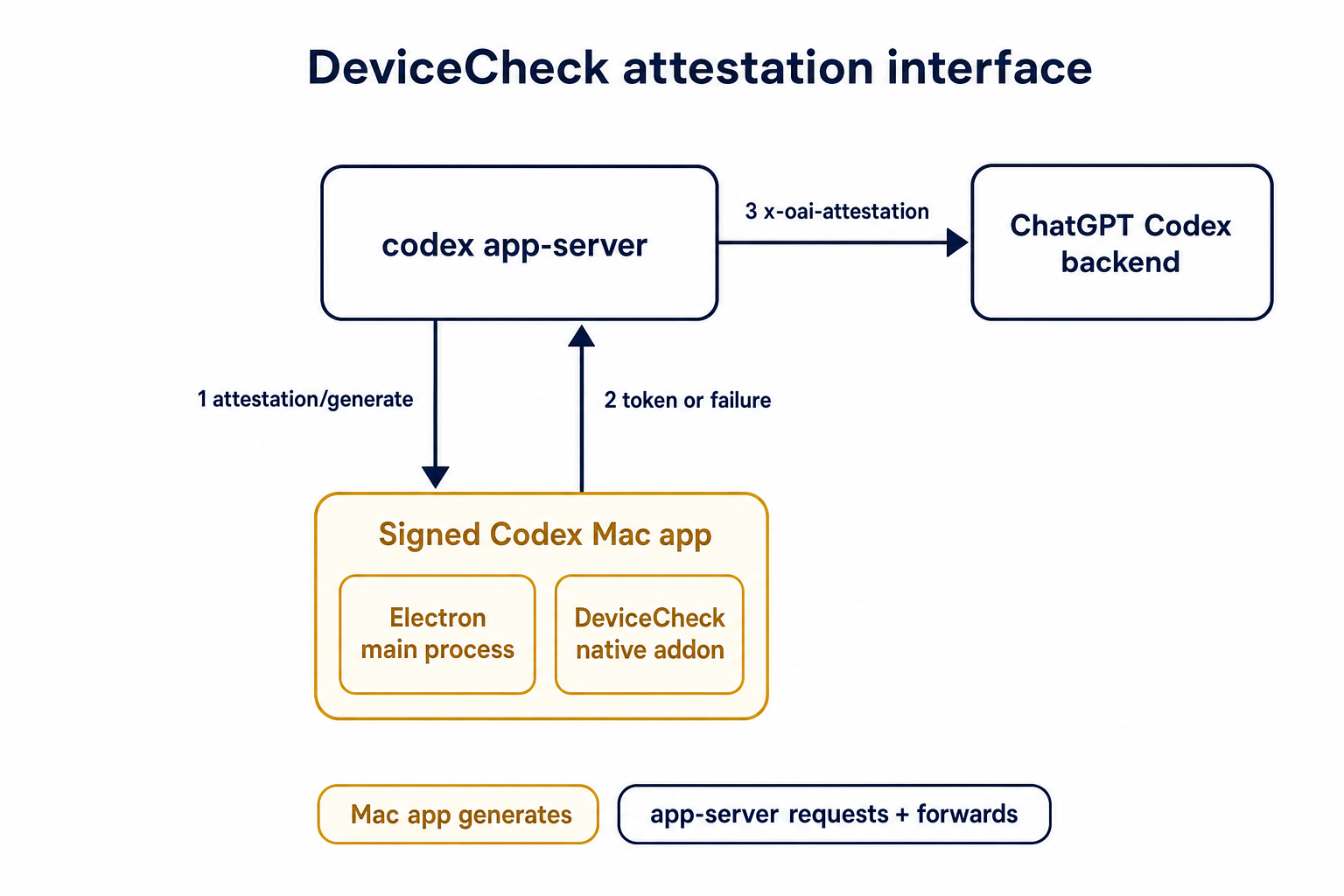
## Details
This PR teaches the Codex app-server runtime how to request and attach
an attestation token. It does not generate DeviceCheck tokens directly;
instead, it relies on the connected desktop app to advertise that it can
generate attestation and then asks that app for a fresh header value
when needed.
The flow is:
1. The Codex desktop app connects to app-server.
2. During `initialize`, the app can advertise that it supports
`requestAttestation`.
3. Before app-server calls selected ChatGPT Codex endpoints, it sends
the internal server request `attestation/generate` to the app.
4. app-server receives a pre-encoded header value back.
5. app-server forwards that value as `x-oai-attestation` on the scoped
outbound requests.
The code in this repo is mostly protocol and runtime plumbing: it adds
the app-server request/response shape, introduces an attestation
provider in core, wires that provider into Responses / compaction /
realtime setup paths, and covers the intended scoping with tests. The
signed macOS DeviceCheck generation remains owned by the desktop app PR.
## Related PR
- Codex desktop app implementation:
https://github.com/openai/openai/pull/878649
## Validation
<details>
<summary>Tests run</summary>
```sh
cargo test -p codex-app-server-protocol
cargo test -p codex-core attestation --lib
cargo test -p codex-app-server --lib attestation
```
Also ran:
```sh
just fix -p codex-core
just fix -p codex-app-server
just fix -p codex-app-server-protocol
just fmt
just write-app-server-schema
```
</details>
<details>
<summary>E2E DeviceCheck validation</summary>
First validated the signed desktop app boundary directly: launched a
packaged signed `Codex.app`, sent `attestation/generate`, decoded the
returned `v1.` attestation header, and validated the extracted
DeviceCheck token with `personal/jm/verify_devicecheck_token.py` using
bundle ID `com.openai.codex`. Apple returned `status_code: 200` and
`is_ok: true`.
Then ran the fuller app + app-server flow. The packaged `Codex.app`
launched a current-branch app-server via `CODEX_CLI_PATH`, and a local
MITM proxy intercepted outbound `chatgpt.com` traffic. The app-server
requested `attestation/generate` from the real Electron app process, and
the intercepted `/backend-api/codex/responses` traffic included
`x-oai-attestation` on both routes:
```text
GET /backend-api/codex/responses Upgrade: websocket x-oai-attestation: present
POST /backend-api/codex/responses Upgrade: none x-oai-attestation: present
```
The captured header decoded to a DeviceCheck token that also validated
with Apple for `com.openai.codex` (`status_code: 200`, `is_ok: true`,
team `2DC432GLL2`).
</details>
---------
Co-authored-by: Codex <noreply@openai.com>
## Why

We want terminal tool review analytics, but the reducer should not stamp
review timing from its own wall clock.

This PR plumbs review timing through the real protocol and app-server
seams so downstream analytics can consume the emitter's timestamps
directly. Guardian reviews keep their enriched `started_at` /
`completed_at` analytics fields by deriving those legacy second-based
values from the same protocol-native millisecond lifecycle timestamps,
rather than sampling a separate analytics clock.

## What changed

- add `started_at_ms` to user approval request payloads
- add `started_at_ms` / `completed_at_ms` to guardian review
notifications
- preserve Guardian review `started_at` / `completed_at` enrichment from
the protocol-native timing source
- stamp typed `ServerResponse` analytics facts with app-server-observed
`completed_at_ms`
- thread the new timing fields through core, protocol, app-server, TUI,
and analytics fixtures

## Verification

- `cargo test -p codex-app-server outgoing_message --manifest-path
codex-rs/Cargo.toml`
- `cargo test -p codex-app-server-protocol guardian --manifest-path
codex-rs/Cargo.toml`
- `cargo test -p codex-tui guardian --manifest-path codex-rs/Cargo.toml`
- `cargo test -p codex-analytics analytics_client_tests --manifest-path
codex-rs/Cargo.toml`

---
[//]: # (BEGIN SAPLING FOOTER)
Stack created with [Sapling](https://sapling-scm.com). Best reviewed
with [ReviewStack](https://reviewstack.dev/openai/codex/pull/21434).
* #18748
* __->__ #21434
* #18747
* #17090
* #17089
* #20514
## Why

With the local model layer and app-server routing in place from PR1,
this PR moves the active TUI runtime onto app-server notifications. The
affected pieces share the same event flow, so the command surface,
session state, bottom-pane prompts, chat rendering, history/status
views, and tests move together to keep the stacked branch buildable.

This PR also removes the obsolete compatibility surface that is no
longer used after the migration. The proposed protocol-boundary verifier
layer was dropped from the stack; enforcing that final boundary will be
simpler once `codex-tui` no longer needs any `codex_protocol`
references.

This PR is part 2 of a 2-PR stack:

1. Add TUI-owned replacement models and extract app-server event
routing.
2. Move the active TUI flow to app-server notifications and delete
obsolete adapter code.

## What changed

- Rewired app command and session handling to use app-server request and
notification shapes.
- Moved approval overlays, request-user-input flows, MCP elicitation,
realtime events, and review commands onto the app-server-facing model
surface.
- Updated chat rendering, history cells, status views, multi-agent UI,
replay state, and TUI tests to use app-server notifications plus the
local models introduced in PR1.
- Deleted `codex-rs/tui/src/app/app_server_adapter.rs` and the
superseded `chatwidget/tests/background_events.rs` fixture path.

## Verification

- `cargo check -p codex-tui --tests`
- Top of stack: `cargo test -p codex-tui`
## Why

`item/permissions/requestApproval` sends a requested permission profile
to app-server clients. The core profile already stores filesystem
permissions as `entries`, but the v2 compatibility conversion used the
legacy `read`/`write` projection whenever possible and left `entries`
unset.

That made the request ambiguous for clients that consume the canonical
v2 shape: `permissions.fileSystem.entries` was missing even though
filesystem access was being requested. A client that rendered or echoed
grants from `entries` could treat the request as having no filesystem
permission entries, then return an empty or incomplete grant. The
app-server intersects responses with the original request, so omitted
filesystem permissions are denied.

## What Changed

- Populate `AdditionalFileSystemPermissions.entries` when converting
legacy read/write roots for request permission payloads, while
preserving `read` and `write` for compatibility.
- Mark `read` and `write` as transitional schema fields in the generated
app-server schema.
- Add regression coverage for the v2 conversion, the app-server
`item/permissions/requestApproval` round trip, and TUI app-server
approval conversion expectations.
- Refresh generated JSON and TypeScript schema fixtures.

## Verification

- `just fmt`
- `cargo test -p codex-app-server-protocol`
- `cargo test -p codex-app-server request_permissions_round_trip`
- `cargo test -p codex-tui
converts_request_permissions_into_granted_permissions`
- `cargo test -p codex-tui
resolves_permissions_and_user_input_through_app_server_request_id`
## Summary
Allow the user to approve a request_permissions_tool request with the
condition that all commands in the rest of the turn are reviewed by
guardian, regardless of sandbox status.

## Testing
- [x] Added unit tests
- [x] Ran locally
## Why

Permission approval responses must not be able to grant more access than
the tool requested. Moving this flow to `PermissionProfile` means the
comparison must be profile-shaped instead of `SandboxPolicy`-shaped, and
cwd-relative special paths such as `:cwd` and `:project_roots` must stay
anchored to the turn that produced the request.

## What changed

This implements semantic `PermissionProfile` intersection in
`codex-sandboxing` for file-system and network permissions. The
intersection accepts narrower path grants, rejects broader grants,
preserves deny-read carve-outs and glob scan depth, and materializes
cwd-dependent special-path grants to absolute paths before they can be
recorded for reuse.

The request-permissions response paths now use that intersection
consistently. App-server captures the request turn cwd before waiting
for the client response, includes that cwd in the v2 approval params,
and core stores the requested profile plus cwd for direct TUI/client
responses and Guardian decisions before recording turn- or
session-scoped grants. The TUI app-server bridge now preserves the
app-server request cwd when converting permission approval params into
core events.

## Verification

- `cargo test -p codex-sandboxing intersect_permission_profiles --
--nocapture`
- `cargo test -p codex-app-server request_permissions_response --
--nocapture`
- `cargo test -p codex-core
request_permissions_response_materializes_session_cwd_grants_before_recording
-- --nocapture`
- `cargo check -p codex-tui --tests`
- `cargo check --tests`
- `cargo test -p codex-tui
app_server_request_permissions_preserves_file_system_permissions`
Deferred dynamic tools need to round-trip a namespace so a tool returned
by `tool_search` can be called through the same registry key that core
uses for dispatch.

This change adds namespace support for dynamic tool specs/calls,
persists it through app-server thread state, and routes dynamic tool
calls by full `ToolName` while still sending the app the leaf tool name.
Deferred dynamic tools must provide a namespace; non-deferred dynamic
tools may remain top-level.

It also introduces `LoadableToolSpec` as the shared
function-or-namespace Responses shape used by both `tool_search` output
and dynamic tool registration, so dynamic tools use the same wrapping
logic in both paths.

Validation:
- `cargo test -p codex-tools`
- `cargo test -p codex-core tool_search`

---------

Co-authored-by: Sayan Sisodiya <sayan@openai.com>
## Why

#18274 made `PermissionProfile` the canonical file-system permissions
shape, but the round-trip from `FileSystemSandboxPolicy` to
`PermissionProfile` still dropped one piece of policy metadata:
`glob_scan_max_depth`.

That field is security-relevant for deny-read globs such as `**/*.env`.
On Linux, bubblewrap sandbox construction uses it to bound unreadable
glob expansion. If a profile copied from active runtime permissions
loses this value and is submitted back as an override, the resulting
`FileSystemSandboxPolicy` can behave differently even though the visible
permission entries look equivalent.

## What changed

- Add `glob_scan_max_depth` to protocol `FileSystemPermissions` and
preserve it when converting to/from `FileSystemSandboxPolicy`.
- Keep legacy `read`/`write` JSON for simple path-only permissions, but
force canonical JSON when glob scan depth is present so the metadata is
not silently dropped.
- Carry `globScanMaxDepth` through app-server
`AdditionalFileSystemPermissions`, generated JSON/TypeScript schemas,
and app-server/TUI conversion call sites.
- Preserve the metadata through sandboxing permission normalization,
merging, and intersection.
- Carry the merged scan depth into the effective
`FileSystemSandboxPolicy` used for command execution, so bounded
deny-read globs reach Linux bubblewrap materialization.

## Verification

- `cargo test -p codex-sandboxing glob_scan -- --nocapture`
- `cargo test -p codex-sandboxing policy_transforms -- --nocapture`
- `just fix -p codex-sandboxing`


---
[//]: # (BEGIN SAPLING FOOTER)
Stack created with [Sapling](https://sapling-scm.com). Best reviewed
with [ReviewStack](https://reviewstack.dev/openai/codex/pull/18713).
* #18288
* #18287
* #18286
* #18285
* #18284
* #18283
* #18282
* #18281
* #18280
* #18279
* #18278
* #18277
* #18276
* #18275
* __->__ #18713
## Why

`PermissionProfile` needs stable, canonical file-system semantics before
it can become the primary runtime permissions abstraction. Without a
canonical form, callers have to keep re-deriving legacy sandbox maps and
profile comparisons remain lossy or order-dependent.

## What changed

This adds canonicalization helpers for `FileSystemPermissions` and
`PermissionProfile`, expands special paths into explicit sandbox
entries, and updates permission request/conversion paths to consume
those canonical entries. It also tightens the legacy bridge so root-wide
write profiles with narrower carveouts are not silently projected as
full-disk legacy access.

## Verification

- `cargo test -p codex-protocol
root_write_with_read_only_child_is_not_full_disk_write -- --nocapture`
- `cargo test -p codex-sandboxing permission -- --nocapture`
- `cargo test -p codex-tui permissions -- --nocapture`
Dismiss stale TUI app-server approvals after remote resolution

When an approval, user-input prompt, or elicitation request is resolved
by another client, the TUI now dismisses the matching local UI instead
of leaving stale prompts behind and emitting a misleading local
cancellation.

This change teaches pending app-server request tracking to map
`serverRequest/resolved` notifications back to the concrete request type
and stable request key, then propagates that resolved request into TUI
prompt state. Approval, request-user-input, and MCP elicitation overlays
now drop the resolved current or queued request quietly, advance to the
next queued request when present, and avoid emitting abort/cancel events
for stale UI.

The latest update also retires matching prompts while they are still
deferred behind active streaming and suppresses buffered active-thread
requests whose app-server request id has already been resolved before
drain. `ChatWidget` removes a resolved request from both the deferred
interrupt queue and the materialized bottom-pane stack, while
active-thread request handling verifies the app-server request is still
pending before showing a prompt. Lifecycle events such as exec begin/end
remain queued so approved work can still render normally.

Tests cover resolved-request mapping, overlay dismissal behavior,
deferred prompt pruning for same-turn user input, exec approval IDs,
lifecycle-event retention, and the buffered active-thread ordering
regression.

Validation:
- `just fmt`
- `git diff --check`
- `cargo test -p codex-tui
resolved_buffered_approval_does_not_become_actionable_after_drain`
- `cargo test -p codex-tui
enqueue_primary_thread_session_replays_buffered_approval_after_attach`
- `cargo test -p codex-tui chatwidget::interrupts`
- `just fix -p codex-tui`

---------

Co-authored-by: Codex <noreply@openai.com>
## Summary

- Add `TimedOut` to Guardian/review carrier types:
  - `ReviewDecision::TimedOut`
  - `GuardianAssessmentStatus::TimedOut`
  - app-server v2 `GuardianApprovalReviewStatus::TimedOut`
- Regenerate app-server JSON/TypeScript schemas for the new wire shape.
- Wire the new status through core/app-server/TUI mappings with
conservative fail-closed handling.
- Keep `TimedOut` non-user-selectable in the approval UI.

**Does not change runtime behavior yet; emitting `TimeOut` and
parent-model timeout messaging will come in followup PRs**
Addresses #16283

Problem: TUI app-server permission approvals could drop filesystem
grants because request and response payloads were round-tripped through
mismatched camelCase and snake_case JSON shapes.
Solution: Replace the lossy JSON round-trips with typed app-server/core
permission conversions so requested and granted permission profiles,
including filesystem paths and scope, are preserved end to end.
This is a follow-up to https://github.com/openai/codex/pull/15922. That
previous PR deleted the old `tui` directory and left the new
`tui_app_server` directory in place. This PR renames `tui_app_server` to
`tui` and fixes up all references.
 riley-oai
