## What changed

- Emit turn-scoped authentication recovery started and completed events when a model provider refreshes expired credentials.
- Add stable `modelProvider/authRecoveryStarted` and `modelProvider/authRecoveryCompleted` app-server notifications with the thread, turn, provider, and user-facing message.
- Show recovery progress in the TUI and `codex exec`, including Amazon Bedrock session reauthentication.

## Testing

- Cover provider recovery success and failure events, app-server routing, client rendering, and Amazon Bedrock credential refresh.

GitOrigin-RevId: 3010c38d0676f18bced27761cf86dd38344d09f9
## Why

Clients need a bounded view of realtime conversations that preserves the order of speech, agent work, and turn lifecycle events without loading the full thread history.

## What changed

- Persist realtime session boundaries, transcript segments, and promoted agent items in paginated thread rollouts.
- Add the experimental `thread/timeline/list` API to page ordinary items, realtime items, and turn boundaries in canonical rollout order. Include `activeRealtimeSessionAtPageStart` so each page can be rendered independently.
- Emit typed `thread/realtime/item/started`, `thread/realtime/item/transcript/delta`, and `thread/realtime/item/completed` notifications around durable realtime items.
- Keep the existing `thread/items/list` response and legacy thread history behavior unchanged.

## Testing

- Cover mixed timeline pagination, realtime-session state at page boundaries, rollout replay, subagent history prefixes, transcript streaming, steering, and promoted agent artifacts.

GitOrigin-RevId: faa2c420192d63e060e8fb32446e3c797422656e
## What changed

- Add experimental `mcpServer/event/stream/start` and `mcpServer/event/stream/stop` requests for hosted apps, plus `mcpServer/event/stream/notification` forwarding.
- Scope subscriptions to the owning app-server connection and subscribed thread, enforce unique IDs and a per-connection limit, and clean them up when the thread is unsubscribed or the connection closes.
- Wait for the MCP active notification before completing startup, retry streams that close immediately, and terminate them when authentication or hosted runtime ownership changes.

## Testing

- Add an app-server integration test covering activation, event forwarding, duplicate subscription rejection, and explicit cancellation.

GitOrigin-RevId: 8a6fc1615adfc5af7e67def3b824fa5909ab3e7b
## What changed

- Add the experimental `autoApprovalReview/strictReviewRequired` app-server notification with the review's `threadId`, `turnId`, and `startedAtMs`.
- Emit it when Guardian v2 leaves an approval review in progress because the action risk is elevated or its score is stale.
- Export the notification through the Rust, TypeScript, and JSON schema surfaces and route it to the associated thread.

## Testing

- Cover strict-review reason tracking for elevated and stale risk scores.
- Verify that high-risk approval routing emits one notification whose identifiers and timestamp match the review-started event.

GitOrigin-RevId: e65352894520bfb756c75b2c95e2e149f9767bb2
## What changed

- Add experimental `thread/queue/add`, `list`, `update`, `delete`, `reorder`, and `start` requests for persistent queued user submissions.
- Automatically dispatch queued submissions in FIFO order after completed or failed turns, while leaving the queue paused after interruption.
- Emit `thread/queue/changed` notifications and expose paginated queue contents with stable submission and client message IDs.
- Export the new protocol types through the generated JSON Schema and TypeScript bindings.

## Testing

- Add app-server integration coverage for capability gating, CRUD, pagination, capacity limits, notifications, automatic dispatch, cold-thread resume, interruption, and explicit queue starts.

GitOrigin-RevId: 89caf5577192199bda77cf6c372a59d26cdd910e
## What changed

- Add the experimental `thread/revert` request, which replaces a loaded paginated thread's durable history with the prefix before `beforeTurnId` while preserving the thread ID.
- Interrupt any active turn, reload the replacement history without unloading the thread, preserve mutable thread settings, and emit `thread/reverted`.
- Return backward pagination cursors for the retained turns and items, reject stale rollout paths after a revert, and document that local file changes are unaffected.

## Testing

- Cover history replacement, pagination, stale paths, missing turns, subsequent turns, active-turn interruption, and preserved thread settings.

GitOrigin-RevId: 435a8163ad4f310cc47219b436f6bdde21f2b83a
## What changed

- Track connected and disconnected states across initial remote exec-server connections and reconnection attempts.
- Emit experimental `thread/environment/connected` and `thread/environment/disconnected` app-server notifications for each thread selecting the environment. Each payload identifies the thread and environment; current state is not replayed when a thread starts.
- Stop forwarding connection events when an environment selection is removed or replaced.

## Testing

- Cover connection, disconnection, reconnection, shared-environment notifications, and replacement of a selected environment.

GitOrigin-RevId: 5dd767372363c4a2a8319fc16164be117d5bd20c
## Why

Clients that account for individual upstream Responses API calls need the exact
usage for each completion rather than accumulated or estimated thread usage.

## What changed

- Add the opt-in `rawResponse/completed` app-server notification with the
  `threadId`, `turnId`, `responseId`, and upstream `usage` payload.
- Emit the transient event for normal turns and compaction requests when
  `experimentalRawEvents` is enabled. The event is not persisted or replayed,
  and `usage` is `null` when the upstream response omits it.
- Export the notification in the app-server schemas and document its behavior.

## Testing

- Cover exact token breakdowns for turn and compaction completions.

GitOrigin-RevId: 49040a060bf1784c1ff1dd62112efb4a778428c4
## Summary

- distinguish expired, non-refreshable stored MCP OAuth credentials from
first-time missing credentials
- carry a typed `failureReason: "reauthenticationRequired"` on the
existing `mcpServer/startupStatus/updated` notification only when user
action is required
- keep the public MCP auth-status API unchanged and regenerate the
app-server protocol schemas and documentation

## Why

An MCP server with an expired access token and no usable refresh token
currently fails startup without giving clients a reliable, typed
recovery signal.

The existing startup-status notification is the natural place to carry
this state. Its nullable `failureReason` keeps the recovery reason
attached to the failed startup transition without adding a one-off
notification. Internally, Codex distinguishes first-time login from
reauthentication and emits the reason only when the startup error itself
requires authentication.

## User impact

App clients can prompt an existing user to reconnect an MCP server when
automatic recovery is impossible by handling a failed
`mcpServer/startupStatus/updated` notification whose `failureReason` is
`reauthenticationRequired`. Starting, ready, cancelled, unrelated
failures, and first-time setup carry no reauthentication reason.

## Companion app PR

- openai/openai#1069582

## Validation

- `just test -p codex-app-server-protocol` — 248 passed; schema fixture
tests passed
- `cargo check -p codex-app-server -p codex-tui`
- `just test -p codex-rmcp-client -p codex-mcp` — 184 passed, 2 skipped
- `just test -p codex-protocol -p codex-app-server-protocol -p
codex-mcp` — 579 passed
- `just write-app-server-schema`
- `just fmt`
Responses API safety buffering metadata currently stops at the transport
boundary, so app-server clients cannot render the in-progress safety
review state.

This change:
- decodes and deduplicates `safety_buffering` metadata from Responses
API SSE and WebSocket events without suppressing the original response
event
- emits a typed core event containing the requested model plus backend
use cases and reasons
- forwards that event as `turn/safetyBuffering/updated` through
app-server v2 and updates generated protocol schemas
- keeps the side-channel event out of persisted rollouts and turn timing

This supports the Codex Apps buffering UX and depends on the Responses
API backend work in https://github.com/openai/openai/pull/1044569 and
https://github.com/openai/openai/pull/1044571.

Validation:
- focused `codex-core` safety-buffering integration test passes
- `cargo check -p codex-core -p codex-app-server -p
codex-app-server-protocol`
- `just fix -p codex-api -p codex-protocol -p codex-core -p
codex-app-server-protocol -p codex-app-server -p codex-rollout -p
codex-rollout-trace -p codex-otel`
- `just fmt`
- broad package test run: 4,430/4,492 passed; 62 unrelated
local-environment/concurrency failures involved unavailable test
binaries, MCP subprocess setup, and app-server timeouts
## Why

Once multi-agent mode can be selected per turn, clients also need to
choose the initial selection when creating a thread and observe that
selection through lifecycle and settings APIs.

The selected value is intentionally distinct from the effective
model-visible value: no client selection is represented as `null`, even
though an eligible multi-agent v2 turn derives `explicitRequestOnly` as
its effective default.

## What changed

- Add the optional experimental `thread/start.multiAgentMode` parameter
and pass it through thread creation.
- Preserve an omitted initial value as an unset selection rather than
eagerly storing `explicitRequestOnly`.
- Apply an explicit `thread/start` selection to the first turn through
the session configuration established at thread creation.
- Restore the latest persisted effective mode as the selected baseline
on cold resume when rollout history contains one.
- Inherit the optional selected mode from a loaded parent when creating
related runtime threads.
- Return the current selected `multiAgentMode` from `thread/start`,
`thread/resume`, `thread/fork`, and thread settings, using `null` when
no mode is selected.
- Keep lifecycle reporting independent from model capability and feature
eligibility; core turn construction remains responsible for calculating
and persisting the effective mode.

## Not covered

- Clearing an existing loaded-session selection back to unset through
`turn/start`; omitted or `null` currently retains the session's
selection.
- A TUI control, slash command, or `config.toml` preference.

## Verification

- `CARGO_INCREMENTAL=0 just test -p codex-app-server-protocol`
- `CARGO_INCREMENTAL=0 just test -p codex-app-server multi_agent_mode`

The focused app-server coverage verifies explicit `thread/start`
initialization, first-turn prompting, nullable reporting for an omitted
selection, and retention of selections that are not currently
runtime-eligible.

## Stack

Stacked on #28685. This PR contains only the thread initialization and
lifecycle/settings API layer.
## What

Server should request:

```
{
  "id": 42,
  "method": "currentTime/read",
  "params": {
    "threadId": "11111111-1111-1111-1111-aaaaafdc2c11"
  }
}
```

Client should respond with something like:

```rust
{
  "id": 42,
  "result": {
    "currentTimeAt": 1781717655
  }
}
```

## Why

Sessions configured with `clock_source = "external"` need a
thread-specific external time source before inference. The system clock
remains the default production provider.

## Validation

- `cargo test -p codex-app-server-protocol`
- `cargo test -p codex-app-server --test all
current_time_read_round_trip_adds_reminder_to_model_input`
- `cargo test -p codex-app-server
first_attestation_capable_connection_for_thread_only_uses_thread_subscribers`
- `cargo test -p codex-analytics`
- `just fix -p codex-app-server-protocol`
- `just fix -p codex-app-server`

Stacked on #28824.
## Summary
- restore `externalAgentConfig/import/progress` notifications while
keeping `externalAgentConfig/import/completed` as the must-deliver event
- persist completed external-agent config imports in state DB by
`importId`, including concrete success/failure details for config,
AGENTS.md, skills, plugins, MCP servers, subagents, hooks, commands, and
sessions
- add `externalAgentConfig/import/readHistories` so clients can recover
persisted import results after missing the live completion notification
- include `errorType` on import failures in protocol
responses/notifications and persisted DB JSON so future code can
classify failures without another wire/storage shape change

## Validation
- `git diff --check`
- `just test -p codex-state external_agent_config_imports`
- `just test -p codex-app-server-protocol`
- `CODEX_SQLITE_HOME=/private/tmp/codex-app-server-sqlite-read-details
just test -p codex-app-server
external_agent_config_import_sends_completion_notification_for_sync_only_import`

Also ran earlier broader checks before publishing:
- `just test -p codex-state`
-
`CODEX_SQLITE_HOME=/private/tmp/codex-app-server-external-agent-test-sqlite
just test -p codex-app-server external_agent_config`
- `just test -p codex-external-agent-migration`
## Why

Clients can archive and unarchive threads today, but there is no
app-server API for permanently removing a thread. Deletion also needs to
cover the full session tree: deleting a main thread should remove
spawned subagent threads and the related local metadata instead of
leaving orphaned rollout files, goals, or subagent state behind.

## What

- Adds the v2 `thread/delete` request and `thread/deleted` notification,
with the response shape kept consistent with `thread/archive`.
- Implements local hard delete for active and archived rollout files.
- Deletes the requested thread's state DB row as the commit point, then
best-effort cleans associated state including spawned descendants,
goals, spawn edges, logs, dynamic tools, and agent job assignments.
- Updates app-server API docs and generated protocol schema/TypeScript
fixtures.
## Why

MCP startup failures from spawned subagents were rendered as global
notifications, so a child thread's failure could pollute the visible
parent transcript. Routing the notification to the child exposed two
related replay problems: session refresh could discard the buffered
event, and a newly created child `ChatWidget` did not know the expected
MCP server set, which could leave its startup spinner running after
every server had settled.

MCP startup diagnostics should remain visible in the thread that owns
the startup without affecting other transcripts. The protocol also needs
to support a future app-scoped MCP lifecycle where startup is not owned
by any thread.

## Reported Behavior

The [originating Slack
report](https://openai.slack.com/archives/C08JZTV654K/p1780604538859939)
called out that using subagents could turn MCP startup failures into a
wall of yellow CLI warnings because repeated failures were not
deduplicated. The intended behavior is for those diagnostics to remain
visible once in the thread that owns the startup, without polluting the
parent transcript.

## What Changed

- add nullable `threadId` ownership to `mcpServer/startupStatus/updated`
- populate it from the app-server conversation ID for the current
thread-scoped lifecycle and regenerate the protocol schema and
TypeScript artifacts
- treat a missing or null `threadId` as app-scoped without injecting it
into the active chat transcript
- route and buffer thread-owned MCP startup notifications by thread in
the TUI
- preserve buffered MCP startup events across child session refresh
- seed expected MCP servers before replaying a thread snapshot so
startup reaches its terminal state
- suppress an identical repeated failure warning for the same server
within one startup round

The owning thread still renders the detailed failure and final `MCP
startup incomplete (...)` summary.

## How to Test

1. Configure an optional MCP server named `smoke` that exits during
initialization.
2. Launch the TUI with multi-agent support enabled.
3. Confirm the main thread's own startup failure renders one detailed
`smoke` warning and one incomplete-startup summary.
4. Spawn exactly one subagent.
5. Confirm the parent transcript does not receive the subagent's MCP
startup failure.
6. Switch to the subagent thread and confirm it contains exactly one
detailed `smoke` failure and one incomplete-startup summary.
7. Confirm the subagent's MCP startup spinner disappears and the thread
remains usable.
8. Switch between the parent and subagent and confirm the warnings
neither move nor duplicate.

Targeted tests:

- `just test -p codex-app-server-protocol`
- `just test -p codex-app-server
thread_start_emits_mcp_server_status_updated_notifications`
- `just test -p codex-tui mcp_startup`

The parent/child behavior and spinner completion were also exercised
manually in tmux. `just argument-comment-lint` was attempted but blocked
by an unrelated local Bazel LLVM empty-glob failure; touched Rust
callsites were inspected manually.
## Why
First-party backends can supply turn-scoped moderation metadata that
app-server clients need for client-side presentation. Exposing this as
an experimental typed notification lets opted-in clients consume it
without interpreting raw Responses API events.

## What changed
- forward `response.metadata.openai_chatgpt_moderation_metadata` from
Responses API SSE and WebSocket streams as turn-scoped moderation
metadata
- emit the experimental app-server v2 `turn/moderationMetadata`
notification with `{ threadId, turnId, metadata }`
- add app-server integration coverage for the typed moderation metadata
notification

## Testing
- `just test -p codex-core
build_ws_client_metadata_includes_window_lineage_and_turn_metadata`
- `just test -p codex-core` (fails locally: 46 failures and 1 timeout,
primarily missing `test_stdio_server` and shell snapshot timeouts)
- `just test -p codex-app-server-protocol`
- `just test -p codex-app-server
turn_moderation_metadata_emits_typed_notification_v2`
- `just test -p codex-app-server` (fails locally: 792 passed, 10 failed,
and 5 timed out; failures are in existing environment-sensitive tests,
primarily because nested macOS `sandbox-exec` is not permitted)
- `just write-app-server-schema --experimental --schema-root
/tmp/codex-app-server-schema-experimental`
Builds on #23502.

## Why

#23502 adds the app-server `thread/settings/update` API and matching
`thread/settings/updated` notification. The TUI already lets users
change thread-scoped settings such as model, reasoning effort, service
tier, approvals, permissions, personality, and collaboration mode, but
those updates need to flow through the app server so embedded and
connected clients observe the same thread state.

This is a rework (simplification) of PR
https://github.com/openai/codex/pull/22510. It has the same
functionality, but the underlying `thread/settings/update` api is now
simpler in that it no longer returns the effective settings as a
response. Now, clients receive the effective settings only through the
`thread/settings/updated` notification.

## What Changed

This updates the TUI to send `thread/settings/update` whenever those
thread-scoped settings change and to treat the RPC response as the
authoritative acknowledgement. It also routes `thread/settings/updated`
notifications back into cached session state and the visible chat widget
so active and inactive threads stay in sync after app-server-originated
changes.

The implementation is kept to the TUI layer: settings conversion and
merge logic live under `codex-rs/tui/src/app/thread_settings.rs`, with
dispatch/routing hooks in the existing app and chat widget paths.

## Verification

I manually tested using `codex app-server --listen unix://` and then
launching two copies of the TUI that use the same local app server. I
then resumed the same thread on both and verified that changes like plan
mode, fast mode, model, reasoning effort, etc. are reflected "live" in
the second client when modified in the first and vice versa.
## Why

App-server clients need a way to update a thread's next-turn settings
without starting a turn, adding transcript content, or waiting for turn
lifecycle events. This gives settings UI a direct path for durable
thread settings while clients observe the eventual effective state
through a notification.

This is a simplified rework of PR
https://github.com/openai/codex/pull/22509. In particular, it changes
the `thread/settings/update` api to return immediately rather than
waiting and returning the effective (updated) thread settings. This
makes the new api consistent with `turn/start` and greatly reduces the
complexity of the implementation relative to the earlier attempt.

## What Changed

- Adds experimental `thread/settings/update` with partial-update request
fields and an empty acknowledgment response.
- Adds experimental `thread/settings/updated`, carrying full effective
`ThreadSettings` and scoped by `threadId` to subscribed clients for the
affected thread.
- Shares durable settings validation with `turn/start`, including
`sandboxPolicy` plus `permissions` rejection and `serviceTier: null`
clearing.
- Emits the same settings notification when `turn/start` overrides
change the stored effective thread settings.
- Regenerates app-server protocol schema fixtures and updates
`app-server/README.md`.
## Summary
TL;DR: teaches `codex-rs` / app-server to request a desktop-provided
attestation token and attach it as `x-oai-attestation` on the scoped
ChatGPT Codex request paths.
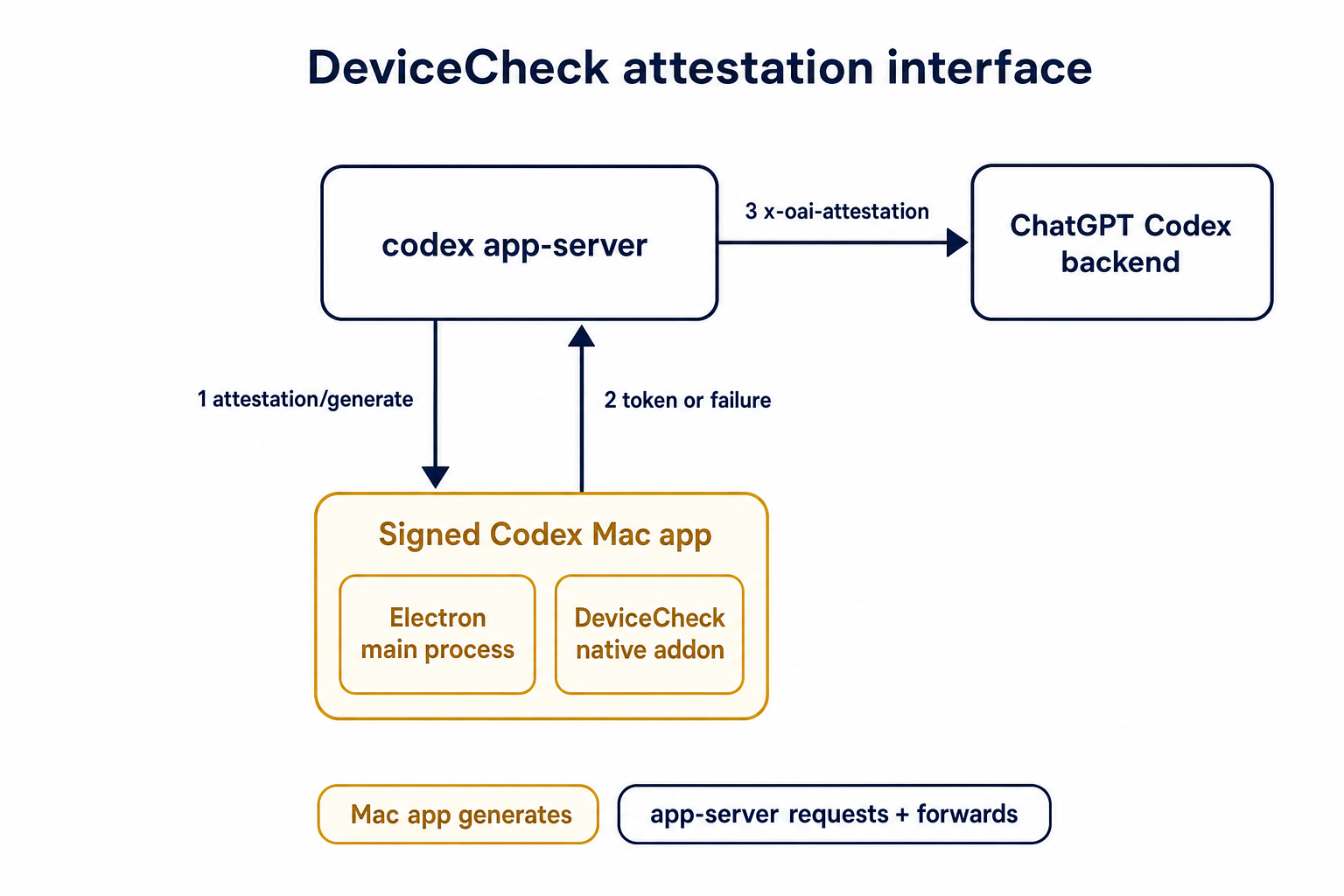
## Details
This PR teaches the Codex app-server runtime how to request and attach
an attestation token. It does not generate DeviceCheck tokens directly;
instead, it relies on the connected desktop app to advertise that it can
generate attestation and then asks that app for a fresh header value
when needed.
The flow is:
1. The Codex desktop app connects to app-server.
2. During `initialize`, the app can advertise that it supports
`requestAttestation`.
3. Before app-server calls selected ChatGPT Codex endpoints, it sends
the internal server request `attestation/generate` to the app.
4. app-server receives a pre-encoded header value back.
5. app-server forwards that value as `x-oai-attestation` on the scoped
outbound requests.
The code in this repo is mostly protocol and runtime plumbing: it adds
the app-server request/response shape, introduces an attestation
provider in core, wires that provider into Responses / compaction /
realtime setup paths, and covers the intended scoping with tests. The
signed macOS DeviceCheck generation remains owned by the desktop app PR.
## Related PR
- Codex desktop app implementation:
https://github.com/openai/openai/pull/878649
## Validation
<details>
<summary>Tests run</summary>
```sh
cargo test -p codex-app-server-protocol
cargo test -p codex-core attestation --lib
cargo test -p codex-app-server --lib attestation
```
Also ran:
```sh
just fix -p codex-core
just fix -p codex-app-server
just fix -p codex-app-server-protocol
just fmt
just write-app-server-schema
```
</details>
<details>
<summary>E2E DeviceCheck validation</summary>
First validated the signed desktop app boundary directly: launched a
packaged signed `Codex.app`, sent `attestation/generate`, decoded the
returned `v1.` attestation header, and validated the extracted
DeviceCheck token with `personal/jm/verify_devicecheck_token.py` using
bundle ID `com.openai.codex`. Apple returned `status_code: 200` and
`is_ok: true`.
Then ran the fuller app + app-server flow. The packaged `Codex.app`
launched a current-branch app-server via `CODEX_CLI_PATH`, and a local
MITM proxy intercepted outbound `chatgpt.com` traffic. The app-server
requested `attestation/generate` from the real Electron app process, and
the intercepted `/backend-api/codex/responses` traffic included
`x-oai-attestation` on both routes:
```text
GET /backend-api/codex/responses Upgrade: websocket x-oai-attestation: present
POST /backend-api/codex/responses Upgrade: none x-oai-attestation: present
```
The captured header decoded to a DeviceCheck token that also validated
with Apple for `com.openai.codex` (`status_code: 200`, `is_ok: true`,
team `2DC432GLL2`).
</details>
---------
Co-authored-by: Codex <noreply@openai.com>
## Why

App-server clients sometimes need argv-based local process execution
while sandbox policy is controlled outside Codex. Those environments can
reject sandbox-disabling paths before a command ever starts, even when
the caller intentionally wants unsandboxed execution.

This PR adds a distinct `process/*` API for that use case instead of
extending `command/exec` with another sandbox-disabling shape. Keeping
the new surface separate also makes the future removal of `command/exec`
simpler: clients that need explicit process lifecycle control can move
to the newer handle-based API without depending on `command/exec`
business logic.

## What changed

- Added v2 process lifecycle methods: `process/spawn`,
`process/writeStdin`, `process/resizePty`, and `process/kill`.
- Added process notifications: `process/outputDelta` for streamed
stdout/stderr chunks and `process/exited` for final exit status and
buffered output.
- Made `process/spawn` intentionally unsandboxed and omitted
sandbox-selection fields such as `sandboxPolicy` and
`permissionProfile`.
- Added client-supplied, connection-scoped `processHandle` values for
follow-up control requests and notification routing.
- Supported cwd, environment overrides, PTY mode and size, stdin
streaming, stdout/stderr streaming, per-stream output caps, and timeout
controls.
- Killed active process sessions when the originating app-server
connection closes.
- Wired the implementation through the modular `request_processors/`
app-server layout, with process-handle request serialization for
follow-up control calls.
- Updated generated JSON/TypeScript schema fixtures and documented the
new API in `codex-rs/app-server/README.md`.
- Added v2 app-server integration coverage in
`codex-rs/app-server/tests/suite/v2/process_exec.rs` for spawn
acknowledgement before exit, buffered output caps, and process
termination.

## Verification

- `cargo test -p codex-app-server-protocol`
- `cargo test -p codex-app-server`

---------

Co-authored-by: Owen Lin <owen@openai.com>
## Why

This stack moves `codex-tui` away from the core protocol event surface
and toward app-server API shapes plus TUI-owned local models. This first
PR sets up the lower-risk foundation: it introduces the local model
surface and extracts app-server event routing into focused TUI modules
while preserving the existing behavior for the larger migration in PR2.

This PR is part 1 of a 2-PR stack:

1. Add TUI-owned replacement models and extract app-server event
routing.
2. Move the active TUI flow to app-server notifications and delete
obsolete adapter code.

## What changed

- Added TUI-owned approval, diff, session state, session resume, token
usage, and user-message models.
- Added `app/app_server_event_targets.rs` and `app/app_server_events.rs`
to hold app-server event targeting and dispatch logic outside `app.rs`.
- Updated app/status tests to use the local model layer and added
focused routing coverage.
- Boxed a few large async TUI test futures so this base layer remains
checkable without overflowing the default test stack.

## Verification

- `cargo check -p codex-tui --tests`
 alexsong-oai
