## Summary
TL;DR: teaches `codex-rs` / app-server to request a desktop-provided
attestation token and attach it as `x-oai-attestation` on the scoped
ChatGPT Codex request paths.
## Details
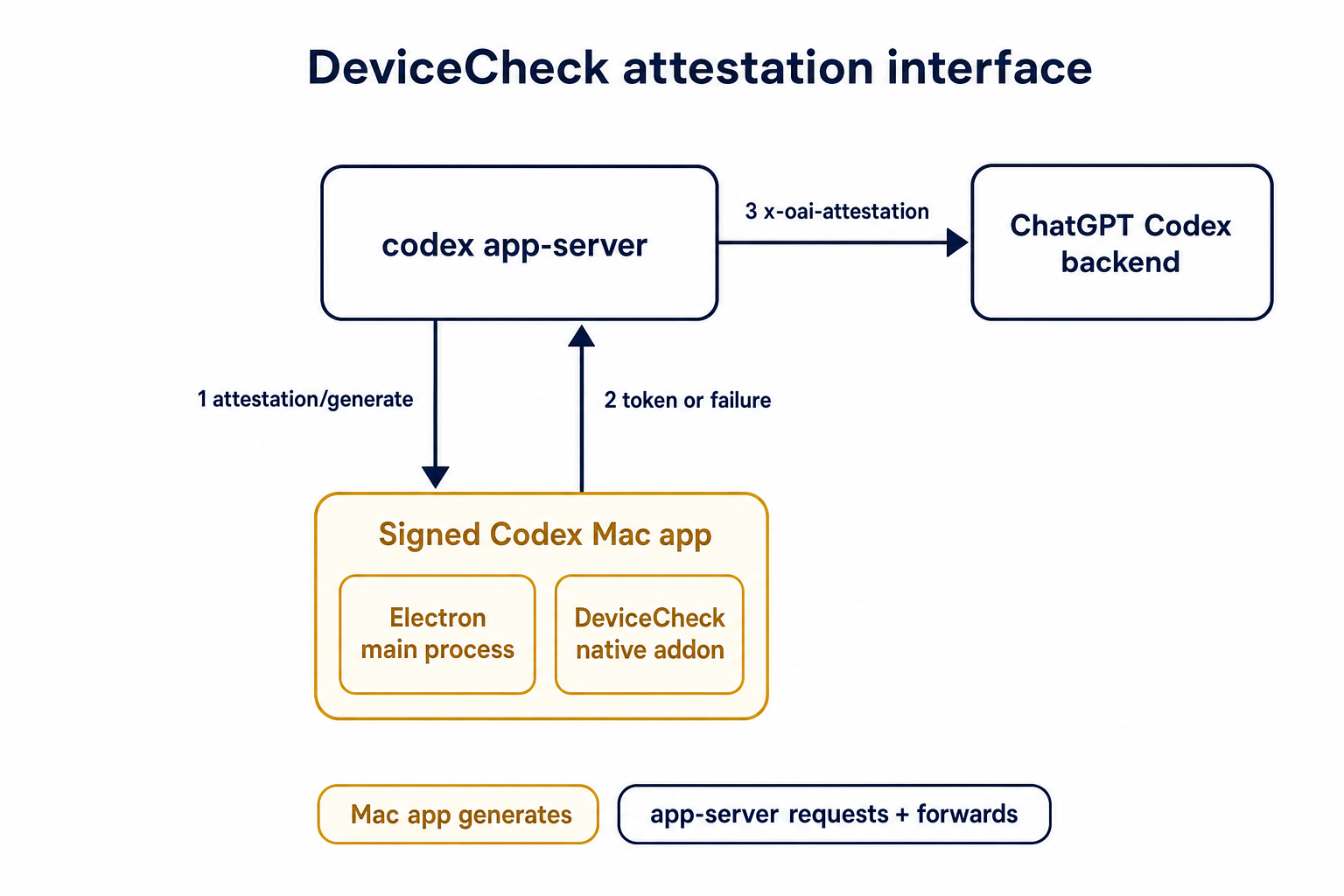
This PR teaches the Codex app-server runtime how to request and attach
an attestation token. It does not generate DeviceCheck tokens directly;
instead, it relies on the connected desktop app to advertise that it can
generate attestation and then asks that app for a fresh header value
when needed.
The flow is:
1. The Codex desktop app connects to app-server.
2. During `initialize`, the app can advertise that it supports
`requestAttestation`.
3. Before app-server calls selected ChatGPT Codex endpoints, it sends
the internal server request `attestation/generate` to the app.
4. app-server receives a pre-encoded header value back.
5. app-server forwards that value as `x-oai-attestation` on the scoped
outbound requests.
The code in this repo is mostly protocol and runtime plumbing: it adds
the app-server request/response shape, introduces an attestation
provider in core, wires that provider into Responses / compaction /
realtime setup paths, and covers the intended scoping with tests. The
signed macOS DeviceCheck generation remains owned by the desktop app PR.
## Related PR
- Codex desktop app implementation:
https://github.com/openai/openai/pull/878649
## Validation
<details>
<summary>Tests run</summary>
```sh
cargo test -p codex-app-server-protocol
cargo test -p codex-core attestation --lib
cargo test -p codex-app-server --lib attestation
```
Also ran:
```sh
just fix -p codex-core
just fix -p codex-app-server
just fix -p codex-app-server-protocol
just fmt
just write-app-server-schema
```
</details>
<details>
<summary>E2E DeviceCheck validation</summary>
First validated the signed desktop app boundary directly: launched a
packaged signed `Codex.app`, sent `attestation/generate`, decoded the
returned `v1.` attestation header, and validated the extracted
DeviceCheck token with `personal/jm/verify_devicecheck_token.py` using
bundle ID `com.openai.codex`. Apple returned `status_code: 200` and
`is_ok: true`.
Then ran the fuller app + app-server flow. The packaged `Codex.app`
launched a current-branch app-server via `CODEX_CLI_PATH`, and a local
MITM proxy intercepted outbound `chatgpt.com` traffic. The app-server
requested `attestation/generate` from the real Electron app process, and
the intercepted `/backend-api/codex/responses` traffic included
`x-oai-attestation` on both routes:
```text
GET /backend-api/codex/responses Upgrade: websocket x-oai-attestation: present
POST /backend-api/codex/responses Upgrade: none x-oai-attestation: present
```
The captured header decoded to a DeviceCheck token that also validated
with Apple for `com.openai.codex` (`status_code: 200`, `is_ok: true`,
team `2DC432GLL2`).
</details>
---------
Co-authored-by: Codex <noreply@openai.com>
## Summary

The TUI app refactor in #18753 moved the old `app.rs` tests into a
single `app/tests.rs` file. That kept the split mechanically simple, but
it left several focused unit tests far from the modules they exercise.

This PR is a follow-up that moves tests next to the code they cover.

It also adds `tui/src/app/test_support.rs` for shared fixture
construction.

This is just a mechanical refactoring (no functional changes) and does
not affect any production code.
## Summary

Side conversations can hide important state changes from the parent
conversation while the user is focused on the side thread. In
particular, the parent may finish, fail, need user input, or require an
approval while the side conversation remains visible. Users need a
lightweight signal for those states, but parent approval overlays should
not interrupt the side conversation itself.

This change adds parent-conversation status to the side conversation
context label and defers parent interactive overlays while side mode is
active. When the user exits side mode, pending parent approvals and
input requests are restored in the main thread. The pending approval
footer avoids duplicating the same parent approval status, and replayed
notice cells are filtered when restoring a pending interactive request
so tips or warnings do not crowd out the approval prompt.

The change is contained to the TUI side-conversation and thread replay
paths.

Example 1: Approval pending
<img width="752" height="35" alt="Screenshot 2026-04-19 at 12 56 07 PM"
src="https://github.com/user-attachments/assets/1cc0f1a3-9cab-4d60-aed2-96523ccafc20"
/>

Example 2: Turn complete
<img width="754" height="35" alt="Screenshot 2026-04-19 at 12 56 27 PM"
src="https://github.com/user-attachments/assets/653521a5-e298-4366-ae1c-72b56eb88eeb"
/>
The TUI supports long-running turns and agent threads, but quick side
questions have required interrupting the main flow or manually
forking/navigating threads. This PR adds a guarded `/side` flow so users
can ask brief side-conversation questions in an ephemeral fork while
keeping the primary thread focused. This also helps address the feature
request in #18125.

The implementation creates one side conversation at a time, lets `/side`
open either an empty side thread or immediately submit `/side
<question>`, and returns to the parent with Esc or Ctrl+C. Side
conversations get hidden developer guardrails that treat inherited
history as reference-only and steer the model away from workspace
mutations unless explicitly requested in the side conversation.

The TUI hides most slash commands while side mode is active, leaving
only `/copy`, `/diff`, `/mention`, and `/status` available there.

