## Summary
Adds include_collaboration_mode_instructions, which is a config
equivalent to include_permissions_instructions for collaboration modes.
Desired for situations where we want to disable this instruction from
entering the context

## Testing
- [x] Added unit test
## Why

Tool dispatch had two serialization mechanisms:

- `supports_parallel_tool_calls` decides whether a tool participates in
the shared parallel-execution lock.
- `is_mutating` separately gated some calls inside dispatch.

That second hook no longer carried its weight. The remaining
parallel-support flag is already the per-tool concurrency policy, so
keeping a second mutating gate made dispatch harder to follow and left
behind extra session plumbing that only existed for that path.

## What changed

- Removed `is_mutating` from tool handlers and deleted the
`tool_call_gate` path that existed only to support it.
- Simplified dispatch and routing to rely on the existing per-tool
`supports_parallel_tool_calls` boolean.
- Dropped the now-unused handler overrides and related session/test
scaffolding.
- Kept the router/parallel tests focused on the surviving per-tool
behavior.
- Removed the unused `codex-utils-readiness` dependency from
`codex-core` as a follow-up fix for `cargo shear`.

## Testing

- `cargo test -p codex-core
parallel_support_does_not_match_namespaced_local_tool_names`
- `cargo test -p codex-core mcp_parallel_support_uses_handler_data`
- `cargo test -p codex-core
tools_without_handlers_do_not_support_parallel`
## Why

Older sessions can contain model-warning records persisted as `user`
messages, including the unified exec process-limit warning, the
`apply_patch`-via-`exec_command` warning, and the model-mismatch
high-risk cyber fallback warning. Those warnings are no longer produced
as conversation history items, but when old sessions compact they should
still be recognized as injected context rather than preserved as real
user turns.

## What changed

- Removed `record_model_warning` and the production paths that emitted
these warning messages into conversation history.
- Added `LegacyUnifiedExecProcessLimitWarning`,
`LegacyApplyPatchExecCommandWarning`, and `LegacyModelMismatchWarning`
contextual fragments that are used only for matching old persisted
messages.
- Registered the legacy fragments with contextual user message detection
so compaction filters them through the existing fragment path.
- Added focused compaction coverage for old warning messages being
dropped during compacted-history processing.

## Testing

- `cargo test -p codex-core warning`
- `just fix -p codex-core`
## Why
The MCP tool path had accumulated a few core-owned special cases: a
dedicated payload variant, resolver plumbing, a legacy `AfterToolUse`
translation path, and a side channel for parallel-call metadata. That
made `ToolRegistry` and the spec builder know more about MCP than they
needed to.

This change moves MCP-specific execution details back onto `ToolInfo`
and `McpHandler` so `codex-core` can treat MCP calls like normal
function calls while still preserving MCP-specific dispatch and
telemetry behavior where it belongs.

## What changed
- removed `resolve_mcp_tool_info`, `ToolPayload::Mcp`, `ToolKind`, and
the remaining registry-side MCP resolver path
- stored MCP routing metadata directly on `McpHandler` and `ToolInfo`,
including `supports_parallel_tool_calls`
- deleted the legacy `AfterToolUse` consumer in `core`, which removes
the need for handler-specific `after_tool_use_payload` implementations
- switched tool-result telemetry to handler-provided tags and kept
MCP-specific dispatch payload construction inside the handler
- simplified tool spec planning/building by passing `ToolInfo` directly
and dropping the direct/deferred MCP wrapper structs and the
parallel-server side table

## Testing
- `cargo check -p codex-core -p codex-mcp -p codex-otel`
- `cargo test -p codex-core
mcp_parallel_support_uses_exact_payload_server`
- `cargo test -p codex-core
direct_mcp_tools_register_namespaced_handlers`
- `cargo test -p codex-core
search_tool_description_lists_each_mcp_source_once`
- `cargo test -p codex-mcp
list_all_tools_uses_startup_snapshot_while_client_is_pending`
- `just fix -p codex-core -p codex-mcp -p codex-otel`
## Why

We've added support for auth elicitation behind the auth_elicitation
flag, but servers need to explicitly check the capability before it
decides to send elicitations in order to be backward compatible. This PR
adds the capability advertising conditioned on the flag.

## What changed

- Build `client_elicitation_capability` from the `AuthElicitation`
feature state.
- Thread that capability through MCP config, session startup, and
`McpConnectionManager` so RMCP initialization advertises the correct
elicitation support.
- Advertise both `form` and `url` elicitation when the feature is
enabled, and preserve the empty default capability when it is disabled.
- Add coverage for the feature-derived config shape and the advertised
initialization payload.

## Testing

- `cargo test -p codex-mcp`
- `cargo test -p codex-core
to_mcp_config_preserves_auth_elicitation_feature_from_config`
- `cargo test -p codex-core` *(currently fails outside this change in
`tools::handlers::multi_agents::tests::tool_handlers_cascade_close_and_resume_and_keep_explicitly_closed_subtrees_closed`
with a stack overflow after unrelated tests have started running)*
## Why

[#21736](https://github.com/openai/codex/pull/21736) introduces the
typed extension API, but the runtime does not yet carry a registry
through thread/session startup or give contributors host-owned stores to
read from. This PR wires that host-side path so later feature migrations
can move product-specific behavior behind typed contributions without
adding another bespoke seam directly to `codex-core`.

## What changed

- Thread `ExtensionRegistry<Config>` through `ThreadManager`,
`CodexSpawnArgs`, `Session`, and sub-agent spawn paths.
- Wire `ThreadStartContributor` and `ContextContributor`
- Expose the small supporting surface needed by non-core callers that
construct threads directly, including `empty_extension_registry()`
through `codex-core-api`.

This PR lands the host plumbing only: the app-server registry is still
empty, and concrete feature migrations are intended to follow
separately.
## Why

PR #21460 reverted the earlier move of skills change watching from
`codex-core` into app-server. This reapplies that boundary change so
app-server owns client-facing `skills/changed` notifications and core no
longer carries the watcher.

## What

- Restore the app-server `SkillsWatcher` and register it from thread
listener setup.
- Remove the core-owned skills watcher and its core live-reload
integration surface.
- Restore app-server coverage for `skills/changed` notifications after a
watched skill file changes.

## Validation

- `cargo test -p codex-app-server --test all
suite::v2::skills_list::skills_changed_notification_is_emitted_after_skill_change
-- --exact --nocapture`
- `cargo test -p codex-core --lib --no-run`
## Summary
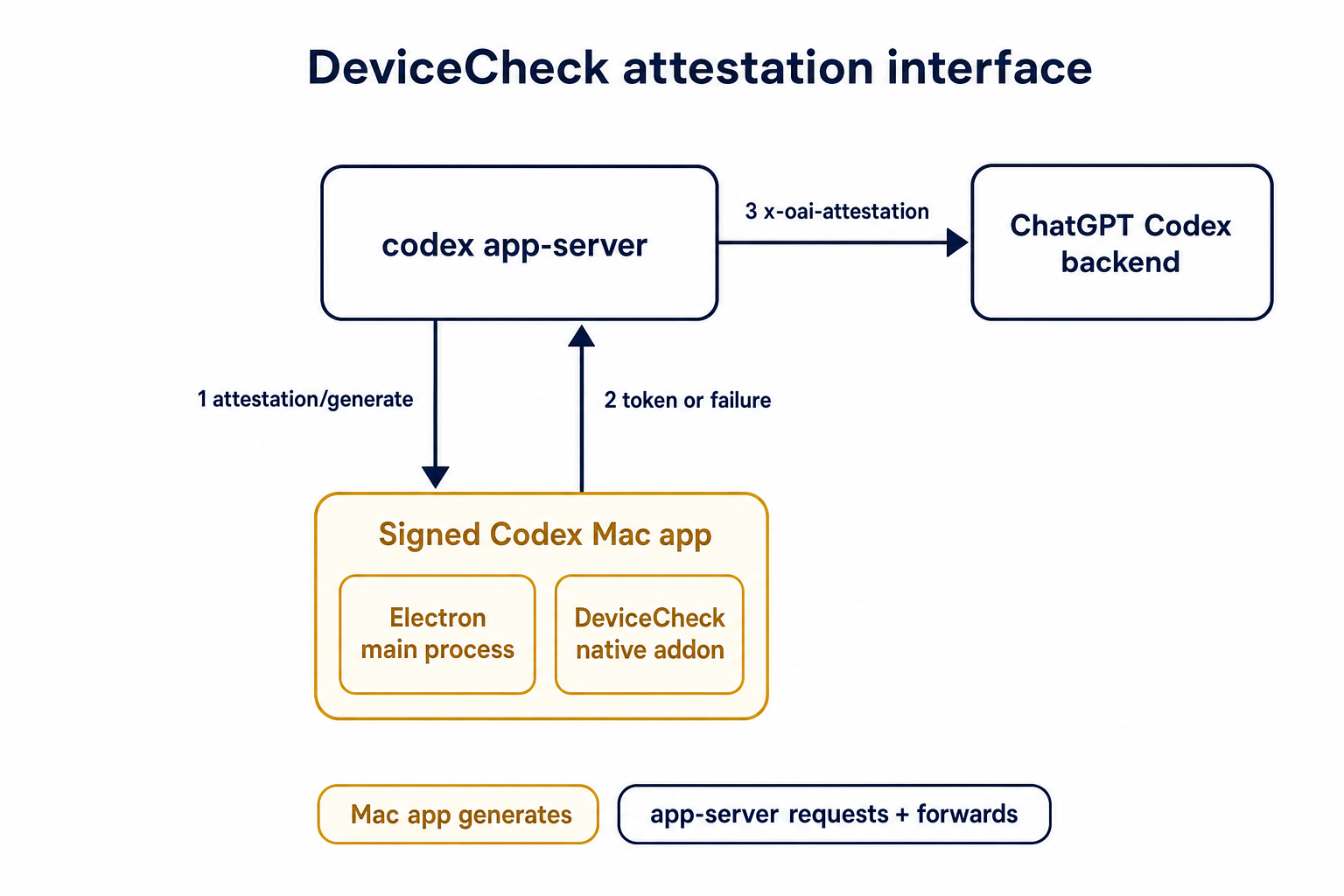
TL;DR: teaches `codex-rs` / app-server to request a desktop-provided
attestation token and attach it as `x-oai-attestation` on the scoped
ChatGPT Codex request paths.
## Details
This PR teaches the Codex app-server runtime how to request and attach
an attestation token. It does not generate DeviceCheck tokens directly;
instead, it relies on the connected desktop app to advertise that it can
generate attestation and then asks that app for a fresh header value
when needed.
The flow is:
1. The Codex desktop app connects to app-server.
2. During `initialize`, the app can advertise that it supports
`requestAttestation`.
3. Before app-server calls selected ChatGPT Codex endpoints, it sends
the internal server request `attestation/generate` to the app.
4. app-server receives a pre-encoded header value back.
5. app-server forwards that value as `x-oai-attestation` on the scoped
outbound requests.
The code in this repo is mostly protocol and runtime plumbing: it adds
the app-server request/response shape, introduces an attestation
provider in core, wires that provider into Responses / compaction /
realtime setup paths, and covers the intended scoping with tests. The
signed macOS DeviceCheck generation remains owned by the desktop app PR.
## Related PR
- Codex desktop app implementation:
https://github.com/openai/openai/pull/878649
## Validation
<details>
<summary>Tests run</summary>
```sh
cargo test -p codex-app-server-protocol
cargo test -p codex-core attestation --lib
cargo test -p codex-app-server --lib attestation
```
Also ran:
```sh
just fix -p codex-core
just fix -p codex-app-server
just fix -p codex-app-server-protocol
just fmt
just write-app-server-schema
```
</details>
<details>
<summary>E2E DeviceCheck validation</summary>
First validated the signed desktop app boundary directly: launched a
packaged signed `Codex.app`, sent `attestation/generate`, decoded the
returned `v1.` attestation header, and validated the extracted
DeviceCheck token with `personal/jm/verify_devicecheck_token.py` using
bundle ID `com.openai.codex`. Apple returned `status_code: 200` and
`is_ok: true`.
Then ran the fuller app + app-server flow. The packaged `Codex.app`
launched a current-branch app-server via `CODEX_CLI_PATH`, and a local
MITM proxy intercepted outbound `chatgpt.com` traffic. The app-server
requested `attestation/generate` from the real Electron app process, and
the intercepted `/backend-api/codex/responses` traffic included
`x-oai-attestation` on both routes:
```text
GET /backend-api/codex/responses Upgrade: websocket x-oai-attestation: present
POST /backend-api/codex/responses Upgrade: none x-oai-attestation: present
```
The captured header decoded to a DeviceCheck token that also validated
with Apple for `com.openai.codex` (`status_code: 200`, `is_ok: true`,
team `2DC432GLL2`).
</details>
---------
Co-authored-by: Codex <noreply@openai.com>
## Why

We want terminal tool review analytics, but the reducer should not stamp
review timing from its own wall clock.

This PR plumbs review timing through the real protocol and app-server
seams so downstream analytics can consume the emitter's timestamps
directly. Guardian reviews keep their enriched `started_at` /
`completed_at` analytics fields by deriving those legacy second-based
values from the same protocol-native millisecond lifecycle timestamps,
rather than sampling a separate analytics clock.

## What changed

- add `started_at_ms` to user approval request payloads
- add `started_at_ms` / `completed_at_ms` to guardian review
notifications
- preserve Guardian review `started_at` / `completed_at` enrichment from
the protocol-native timing source
- stamp typed `ServerResponse` analytics facts with app-server-observed
`completed_at_ms`
- thread the new timing fields through core, protocol, app-server, TUI,
and analytics fixtures

## Verification

- `cargo test -p codex-app-server outgoing_message --manifest-path
codex-rs/Cargo.toml`
- `cargo test -p codex-app-server-protocol guardian --manifest-path
codex-rs/Cargo.toml`
- `cargo test -p codex-tui guardian --manifest-path codex-rs/Cargo.toml`
- `cargo test -p codex-analytics analytics_client_tests --manifest-path
codex-rs/Cargo.toml`

---
[//]: # (BEGIN SAPLING FOOTER)
Stack created with [Sapling](https://sapling-scm.com). Best reviewed
with [ReviewStack](https://reviewstack.dev/openai/codex/pull/21434).
* #18748
* __->__ #21434
* #18747
* #17090
* #17089
* #20514
- Route live thread renames through `ThreadStore` metadata updates.
- Read resumed thread names from store metadata with legacy local
fallback preserved in the store.
## Why

App-server config writes were leaving existing threads partially stale.
After a config mutation, the app-server told each live thread to run
`Op::ReloadUserConfig`, but that path only re-read the user
`config.toml` layer. Settings that came from the app-server's
materialized config snapshot did not propagate to existing threads until
restart.

This change prevent a FS access from `core` for CCA.

## What changed

- add `CodexThread::refresh_runtime_config()` and
`Session::refresh_runtime_config()` so the app-server can push a freshly
rebuilt config snapshot into a live thread
- rebuild the latest config with each thread's `cwd` after config
mutations, then refresh the thread from that snapshot instead of asking
it to reload only `config.toml`
- keep session-static settings unchanged during refresh, while updating
runtime-refreshable state such as the config layer stack,
`tool_suggest`, and derived hook/plugin/skill state
- keep `reload_user_config_layer()` as the file-backed fallback for
legacy local reload flows, but route the shared refresh logic through
the new runtime refresh path

## Testing

- add a session test that verifies `refresh_runtime_config()` rebuilds
hooks from refreshed config
- add a session test that verifies runtime-refreshable fields update
while session-static settings like `model` and `notify` stay unchanged

---------

Co-authored-by: Codex <noreply@openai.com>
## DISCLAIMER
This is experimental and no production service must rely on this

## Why

Built-in MCPs are product-owned runtime capabilities, but they were
previously flattened into the same config-backed stdio path as
user-configured servers. That made them depend on a hidden `codex
builtin-mcp` re-exec path, exposed them through config-oriented CLI
flows, and erased distinctions the runtime needs to preserve—most
notably whether an MCP call should count as external context for
memory-mode pollution.

## What changed

- Model product-owned built-ins separately from config-backed MCP
servers via `BuiltinMcpServer` and `EffectiveMcpServer`.
- Launch built-ins in process through a reusable async transport instead
of the hidden `builtin-mcp` stdio subcommand.
- Keep config-oriented CLI operations such as `codex mcp
list/get/login/logout` scoped to configured servers, while merging
built-ins only into the effective runtime server set.
- Retain server metadata after launch so parallel-tool support and
context classification come from the live server set; built-in
`memories` is now classified as local Codex state rather than external
context.

## Test plan

- `cargo test -p codex-mcp`
- `cargo test -p codex-core --test suite
builtin_memories_mcp_call_does_not_mark_thread_memory_mode_polluted_when_configured`

---------

Co-authored-by: Codex <noreply@openai.com>
## Why

Reverts #20689 to restore the previous optional state DB plumbing. The
conflict resolution keeps the newer installation ID and session/thread
identity changes that landed after #20689, while removing the mandatory
state DB and agent graph store dependency from ThreadManager
construction.

## What changed

- Restored `Option<StateDbHandle>` through app-server, MCP server,
prompt debug, and test entry points.
- Removed the `codex-core` dependency on `codex-agent-graph-store` and
reverted descendant lookup back to the existing state DB path when
available.
- Kept newer `installation_id` forwarding by passing it beside the
optional DB handle.
- Kept local thread-name updates working when the optional state DB
handle is absent.

## Validation

- `git diff --check`
- `cargo test -p codex-thread-store`
- `cargo test -p codex-state -p codex-rollout -p
codex-app-server-protocol`
- Attempted `env CARGO_INCREMENTAL=0 cargo test -p codex-core -p
codex-app-server -p codex-app-server-client -p codex-mcp-server -p
codex-thread-manager-sample -p codex-tui`; blocked locally by a rustc
ICE while compiling `v8 v146.4.0` with `rustc 1.93.0 (254b59607
2026-01-19)` on `aarch64-apple-darwin`.
## Why

Skills update notifications are app-server API behavior, but the watcher
lived in `codex-core` and surfaced through
`EventMsg::SkillsUpdateAvailable`. Moving the watcher out keeps core
focused on thread execution and lets app-server own both cache
invalidation and the `skills/changed` notification.

## What changed

- Added an app-server-owned skills watcher that watches local skill
roots, clears the shared skills cache, and emits `skills/changed`
directly.
- Registers skill watches from the common app-server thread listener
attach path, including direct starts, resumes, and app-server-observed
child or forked threads.
- Stores the `WatchRegistration` on `ThreadState`, so listener
replacement, thread teardown, idle unload, and app-server shutdown
deregister by dropping the RAII guard.
- Removed `EventMsg::SkillsUpdateAvailable`, the core watcher, and the
old core live-reload test.
- Extended the app-server skills change test to verify a cached skills
list is refreshed after a filesystem change without forcing reload.

## Validation

- `cargo check -p codex-core -p codex-app-server -p codex-mcp-server -p
codex-rollout -p codex-rollout-trace`
- `cargo test -p codex-app-server
skills_changed_notification_is_emitted_after_skill_change`
## Summary
- make resolved turn environment shell metadata optional instead of
hard-coding bash
- render environment context shells from explicit environment metadata
when present, falling back to the existing session shell
- update environment context tests for inherited PowerShell-style
fallback and explicit per-environment shell override

## Testing
- Not run (not requested; formatted with `just fmt`).

Co-authored-by: Codex <noreply@openai.com>
## Summary

- resolve or inject the installation ID before core startup and pass it
through `ThreadManager`, `CodexSpawnArgs`, and `Session` as a plain
`String`
- keep child sessions on the parent installation ID instead of
rediscovering it inside core
- propagate installation ID startup failures in `mcp-server` instead of
panicking

## Why

Core was still touching the filesystem on the session startup path to
discover `installation_id`. This moves that work to the outer host
boundary so core no longer depends on `codex_home` reads during session
construction.

---------

Co-authored-by: Codex <noreply@openai.com>
## Summary
- make `thread_source` an explicit optional thread-level field on
`thread/start`, `thread/fork`, and returned thread payloads
- persist `thread_source` in rollout/session metadata so resumed live
threads retain the original value
- replace the old best-effort `session_source` -> `thread_source`
mapping with an explicit caller-supplied analytics classification

## Why
Before this change, analytics `thread_source` was populated by a
best-effort mapping from `session_source`. `session_source` describes
the runtime/client surface, not the actual thread-level origin, so that
projection was not accurate enough to distinguish cases such as `user`,
`subagent`, `memory_consolidation`, and future thread origins reliably.

Making `thread_source` explicit keeps one thread-level analytics field
while letting callers provide the real classification directly instead
of recovering it indirectly from `session_source`.

## Impact
For new analytics events, `thread_source` now reflects the explicit
thread-level classification supplied by the caller rather than an
inferred value derived from `session_source`. Existing protocol fields
remain optional; callers that omit `threadSource` now produce `null`
instead of a best-effort inferred value.

## Validation
- `just write-app-server-schema`
- `cargo test -p codex-analytics -p codex-core -p
codex-app-server-protocol --no-run`
- `cargo test -p codex-app-server-protocol
generated_ts_optional_nullable_fields_only_in_params`
- `cargo test -p codex-analytics
thread_initialized_event_serializes_expected_shape`
- `cargo test -p codex-core
resume_stopped_thread_from_rollout_preserves_thread_source`
## Why

`skills/list` is already exposed through app-server v2 and covered by
the app-server test suite. Keeping the separate core `Op::ListSkills`
path leaves a duplicate legacy protocol surface that no longer needs to
be maintained.

## What Changed

- Removed `Op::ListSkills` and `EventMsg::ListSkillsResponse` from the
core protocol.
- Deleted the corresponding core session handler and stale core
integration tests.
- Removed rollout/MCP ignore branches and protocol v1 docs references
for the deleted event/op.
- Left app-server `skills/list` and its existing coverage intact.

## Validation

- `cargo test -p codex-protocol`
- `cargo test -p codex-core --test all suite::skills`
- `cargo check -p codex-mcp-server -p codex-rollout -p
codex-rollout-trace`
- `just fix -p codex-core`
## Why

We want the agent graph store to be passed down the stack as a real
dependency, the same way we already treat the thread store.

This will let us inject the agent graph store as a real dependency and
support implementations other than the local SQLite-backed one. Right
now most code instantiates a state DB and an agent graph store
just-in-time. Ideally, we would not depend on the state DB directly but
only read through the higher-level interfaces.

This change makes the dependency boundaries explicit and moves state DB
initialization to process bootstrap instead of hiding it inside local
store implementations.

## What changed

- `ThreadManager` now requires a `StateDbHandle` and an
`AgentGraphStore` at construction time instead of treating them as
optional internals.
- The local store constructors no longer lazily initialize SQLite.
Callers now initialize the state DB once per process and use that shared
handle to build:
  - `LocalThreadStore`
  - `LocalAgentGraphStore`
- App bootstraps (`app-server`, `mcp-server`, `prompt_debug`, and the
thread-manager sample) now initialize the state DB up front and inject
the resulting handle down the stack.
- `app-server` now consistently uses its process-scoped state DB handle
instead of reopening SQLite or trying to recover it from loaded threads.
- Device-key storage now reuses the shared state DB handle instead of
maintaining its own lazy opener.
- The thread archive / descendant traversal paths now use the injected
`AgentGraphStore` instead of reaching through local
thread-store-specific state.

## Verification

- `cargo check -p codex-core -p codex-thread-store -p codex-app-server
-p codex-mcp-server -p codex-thread-manager-sample --tests`
- `cargo test -p codex-thread-store`
- `cargo test -p codex-core
thread_manager_accepts_separate_agent_graph_store_and_thread_store --
--nocapture`
- `cargo test -p codex-app-server
thread_archive_archives_spawned_descendants -- --nocapture`
## Summary

Xcode 26.4 was built against app-server behavior from before MCP
elicitation requests became client-visible in CLI 0.120.0 via #17043.
That client line does not expect the new events/messages, so this PR
restores the old behavior for exactly that client/version combination.

The compatibility handling stays in the app-server layer: when the
initialized client is `Xcode` and its version starts with `26.4`, the
app server marks the live Codex thread so MCP elicitations are
auto-denied. The flag is applied on thread start/resume/fork/turn
attachment, carried through `Codex`/`CodexThread`, and stored on
`McpConnectionManager` so refreshed MCP managers preserve the behavior.

## Notes

This is intentionally narrow and includes a TODO to remove the
compatibility path once Xcode 26.4 ages out.
## Why

Tool families already disagree on what their existing `duration` fields
mean, so lifecycle latency should live on the shared item envelope
instead of being inferred from per-tool execution fields. Carrying that
envelope through app-server notifications gives downstream consumers one
reusable timing signal without pretending every tool has the same
execution semantics.

## What changed

- Adds `started_at_ms` to core `ItemStartedEvent` values and
`completed_at_ms` to core `ItemCompletedEvent` values.
- Populates those timestamps in the shared session lifecycle emitters,
so protocol-native items get timing without each producer tracking its
own clock state.
- Exposes `startedAtMs` on app-server `item/started` notifications and
`completedAtMs` on `item/completed` notifications.
- Maps the lifecycle timestamps through the app-server boundary while
leaving legacy-converted notifications nullable when no lifecycle
timestamp exists.
- Regenerates the app-server JSON schema and TypeScript fixtures for the
notification-envelope change and updates downstream fixtures that
construct those notifications directly.
- Extends the existing web-search and image-generation integration flows
to assert the new lifecycle timestamps on the native item events.

## Verification

- `cargo check -p codex-protocol -p codex-core -p
codex-app-server-protocol -p codex-app-server -p codex-tui -p codex-exec
-p codex-app-server-client`
- `cargo test -p codex-core --test all web_search_item_is_emitted`
- `cargo test -p codex-core --test all
image_generation_call_event_is_emitted`
- `cargo test -p codex-app-server-protocol`

---
[//]: # (BEGIN SAPLING FOOTER)
Stack created with [Sapling](https://sapling-scm.com). Best reviewed
with [ReviewStack](https://reviewstack.dev/openai/codex/pull/20514).
* #18748
* #18747
* #17090
* #17089
* __->__ #20514
## Why

SQLite state was still being opened from consumer paths, including lazy
`OnceCell`-backed thread-store call sites. That let one process
construct multiple state DB connections for the same Codex home, which
makes SQLite lock contention and `database is locked` failures much
easier to hit.

State DB lifetime should be chosen by main-like entrypoints and tests,
then passed through explicitly. Consumers should use the supplied
`Option<StateDbHandle>` or `StateDbHandle` and keep their existing
filesystem fallback or error behavior when no handle is available.

The startup path also needs to keep the rollout crate in charge of
SQLite state initialization. Opening `codex_state::StateRuntime`
directly bypasses rollout metadata backfill, so entrypoints should
initialize through `codex_rollout::state_db` and receive a handle only
after required rollout backfills have completed.

## What Changed

- Initialize the state DB in main-like entrypoints for CLI, TUI,
app-server, exec, MCP server, and the thread-manager sample.
- Pass `Option<StateDbHandle>` through `ThreadManager`,
`LocalThreadStore`, app-server processors, TUI app wiring, rollout
listing/recording, personality migration, shell snapshot cleanup,
session-name lookup, and memory/device-key consumers.
- Remove the lazy local state DB wrapper from the thread store so
non-test consumers use only the supplied handle or their existing
fallback path.
- Make `codex_rollout::state_db::init` the local state startup path: it
opens/migrates SQLite, runs rollout metadata backfill when needed, waits
for concurrent backfill workers up to a bounded timeout, verifies
completion, and then returns the initialized handle.
- Keep optional/non-owning SQLite helpers, such as remote TUI local
reads, as open-only paths that do not run startup backfill.
- Switch app-server startup from direct
`codex_state::StateRuntime::init` to the rollout state initializer so
app-server cannot skip rollout backfill.
- Collapse split rollout lookup/list APIs so callers use the normal
methods with an optional state handle instead of `_with_state_db`
variants.
- Restore `getConversationSummary(ThreadId)` to delegate through
`ThreadStore::read_thread` instead of a LocalThreadStore-specific
rollout path special case.
- Keep DB-backed rollout path lookup keyed on the DB row and file
existence, without imposing the filesystem filename convention on
existing DB rows.
- Verify readable DB-backed rollout paths against `session_meta.id`
before returning them, so a stale SQLite row that points at another
thread's JSONL falls back to filesystem search and read-repairs the DB
row.
- Keep `debug prompt-input` filesystem-only so a one-off debug command
does not initialize or backfill SQLite state just to print prompt input.
- Keep goal-session test Codex homes alive only in the goal-specific
helper, rather than leaking tempdirs from the shared session test
helper.
- Update tests and call sites to pass explicit state handles where DB
behavior is expected and explicit `None` where filesystem-only behavior
is intended.

## Validation

- `CARGO_TARGET_DIR=/tmp/codex-target-state-db cargo check -p
codex-rollout -p codex-thread-store -p codex-app-server -p codex-core -p
codex-tui -p codex-exec -p codex-cli --tests`
- `CARGO_TARGET_DIR=/tmp/codex-target-state-db cargo test -p
codex-rollout state_db_`
- `CARGO_TARGET_DIR=/tmp/codex-target-state-db cargo test -p
codex-rollout find_thread_path`
- `CARGO_TARGET_DIR=/tmp/codex-target-state-db cargo test -p
codex-rollout find_thread_path -- --nocapture`
- `CARGO_TARGET_DIR=/tmp/codex-target-state-db cargo test -p
codex-rollout try_init_ -- --nocapture`
- `CARGO_TARGET_DIR=/tmp/codex-target-state-db cargo test -p
codex-rollout`
- `CARGO_TARGET_DIR=/tmp/codex-target-state-db cargo clippy -p
codex-rollout --lib -- -D warnings`
- `CARGO_TARGET_DIR=/tmp/codex-target-state-db cargo test -p
codex-thread-store
read_thread_falls_back_when_sqlite_path_points_to_another_thread --
--nocapture`
- `CARGO_TARGET_DIR=/tmp/codex-target-state-db cargo test -p
codex-thread-store`
- `CARGO_TARGET_DIR=/tmp/codex-target-state-db cargo test -p codex-core
shell_snapshot`
- `CARGO_TARGET_DIR=/tmp/codex-target-state-db cargo test -p codex-core
--test all personality_migration`
- `CARGO_TARGET_DIR=/tmp/codex-target-state-db cargo test -p codex-core
--test all rollout_list_find`
- `RUST_MIN_STACK=8388608 CODEX_SKIP_VENDORED_BWRAP=1
CARGO_TARGET_DIR=/tmp/codex-target-state-db cargo test -p codex-core
--test all rollout_list_find::find_prefers_sqlite_path_by_id --
--nocapture`
- `RUST_MIN_STACK=8388608 CODEX_SKIP_VENDORED_BWRAP=1
CARGO_TARGET_DIR=/tmp/codex-target-state-db cargo test -p codex-core
--test all rollout_list_find -- --nocapture`
- `CARGO_TARGET_DIR=/tmp/codex-target-state-db cargo test -p codex-core
interrupt_accounts_active_goal_before_pausing`
- `CARGO_TARGET_DIR=/tmp/codex-target-state-db cargo test -p
codex-app-server get_auth_status -- --test-threads=1`
- `CODEX_SKIP_VENDORED_BWRAP=1
CARGO_TARGET_DIR=/tmp/codex-target-state-db cargo test -p
codex-app-server --lib`
- `CODEX_SKIP_VENDORED_BWRAP=1
CARGO_TARGET_DIR=/tmp/codex-target-state-db cargo check -p codex-rollout
-p codex-app-server --tests`
- `CARGO_TARGET_DIR=/tmp/codex-target-state-db just fix -p codex-rollout
-p codex-thread-store -p codex-core -p codex-app-server -p codex-tui -p
codex-exec -p codex-cli`
- `CODEX_SKIP_VENDORED_BWRAP=1
CARGO_TARGET_DIR=/tmp/codex-target-state-db just fix -p codex-rollout -p
codex-app-server`
- `CARGO_TARGET_DIR=/tmp/codex-target-state-db just fix -p
codex-rollout`
- `CODEX_SKIP_VENDORED_BWRAP=1
CARGO_TARGET_DIR=/tmp/codex-target-state-db just fix -p codex-core`
- `just argument-comment-lint -p codex-core`
- `just argument-comment-lint -p codex-rollout`

Focused coverage added in `codex-rollout`:

- `recorder::tests::state_db_init_backfills_before_returning` verifies
the rollout metadata row exists before startup init returns.
- `state_db::tests::try_init_waits_for_concurrent_startup_backfill`
verifies startup waits for another worker to finish backfill instead of
disabling the handle for the process.
-
`state_db::tests::try_init_times_out_waiting_for_stuck_startup_backfill`
verifies startup does not hang indefinitely on a stuck backfill lease.
-
`tests::find_thread_path_accepts_existing_state_db_path_without_canonical_filename`
verifies DB-backed lookup accepts valid existing rollout paths even when
the filename does not include the thread UUID.
-
`tests::find_thread_path_falls_back_when_db_path_points_to_another_thread`
verifies DB-backed lookup ignores a stale row whose existing path
belongs to another thread and read-repairs the row after filesystem
fallback.

Focused coverage updated in `codex-core`:

- `rollout_list_find::find_prefers_sqlite_path_by_id` now uses a
DB-preferred rollout file with matching `session_meta.id`, so it still
verifies that valid SQLite paths win without depending on stale/empty
rollout contents.

`cargo test -p codex-app-server thread_list_respects_search_term_filter
-- --test-threads=1 --nocapture` was attempted locally but timed out
waiting for the app-server test harness `initialize` response before
reaching the changed thread-list code path.

`bazel test //codex-rs/thread-store:thread-store-unit-tests
--test_output=errors` was attempted locally after the thread-store fix,
but this container failed before target analysis while fetching `v8+`
through BuildBuddy/direct GitHub. The equivalent local crate coverage,
including `cargo test -p codex-thread-store`, passes.

A plain local `cargo check -p codex-rollout -p codex-app-server --tests`
also requires system `libcap.pc` for `codex-linux-sandbox`; the
follow-up app-server check above used `CODEX_SKIP_VENDORED_BWRAP=1` in
this container.
## Why
This is a prep PR in the multi-environment process-tool stack. It
separates ownership/config cleanup from the behavior change that teaches
process tools to route by selected environment, so the follow-up PR can
focus on model-facing `environment_id` behavior.

## Stack
1. https://github.com/openai/codex/pull/20646 - `EnvironmentContext`
rendering for selected environments
2. https://github.com/openai/codex/pull/20669 - selected-environment
ownership and tool config prep (this PR)
3. https://github.com/openai/codex/pull/20647 - process-tool
`environment_id` routing

## What Changed
- keep the resolved turn environment list wrapped in
`ResolvedTurnEnvironments` through `TurnContext` instead of unwrapping
it back to a raw `Vec`
- add `TurnContext::resolve_path_against` so cwd-relative path
resolution has one shared helper
- replace the old tool config boolean with `ToolEnvironmentMode::{None,
Single, Multiple}`

## Testing
- Tests not run locally; this prep refactor is covered by GitHub CI for
the stack.

Co-authored-by: Codex <noreply@openai.com>
## Why

This adds the `remote_compaction_v2` client path so remote compaction
can run through the normal Responses stream and install a
`context_compaction` item that trigger a compaction.

The goal is to migrate some of the compaction logic on the client side

We keeps the v2 transport behind a feature flag while letting follow-up
requests reuse the compacted context instead of falling back to the
legacy compaction item shape.

## What changed

- add `ResponseItem::ContextCompaction` and refresh the generated
app-server / schema / TypeScript fixtures that expose response items on
the wire
- add `core/src/compact_remote_v2.rs` to send compaction through the
standard streamed Responses client, require exactly one
`context_compaction` output item, and install that item into compacted
history
- route manual compact and auto-compaction through the v2 path when
`remote_compaction_v2` is enabled, while keeping the existing remote
compaction path as the fallback
- preserve the new item type across history retention, follow-up request
construction, telemetry, rollout persistence, and rollout-trace
normalization
- add targeted coverage for the feature flag, `context_compaction`
serialization, rollout-trace normalization, and remote-compaction
follow-up behavior

## Verification

- added protocol tests for `context_compaction`
serialization/deserialization in `protocol/src/models.rs`
- added rollout-trace coverage for `context_compaction` normalization in
`rollout-trace/src/reducer/conversation_tests.rs`
- added remote compaction integration coverage for v2 follow-up reuse
and mixed compaction output streams in
`core/tests/suite/compact_remote.rs`

---------

Co-authored-by: Codex <noreply@openai.com>
## Why
The model needs a way to see which environments are available during a
multi-environment turn without changing the legacy single-environment
prompt surface or pulling replay/persistence changes into the same
review.

## Stack
1. https://github.com/openai/codex/pull/20646 - `EnvironmentContext`
rendering for selected environments (this PR)
2. https://github.com/openai/codex/pull/20669 - selected-environment
ownership and tool config prep
3. https://github.com/openai/codex/pull/20647 - process-tool
`environment_id` routing

## What Changed
- extend `environment_context` so multi-environment turns render an
`<environments>` block with the selected environment ids and cwd values
- keep zero- and single-environment turns on the existing cwd-only
render path
- keep replay and persistence paths on the legacy surface for now so
this PR stays scoped to live prompt rendering
- add focused coverage in
`codex-rs/core/src/context/environment_context_tests.rs`

## Testing
- CI

---------

Co-authored-by: Codex <noreply@openai.com>
## Summary
- make selected turn environments the source of truth for session
runtime cwd and MCP runtime environment selection
- keep local/no-selection fallback behavior intact
- add coverage for duplicate selected environments, cwd resolution, and
MCP runtime environment selection

## Validation
- git diff --check
- rustfmt was run on touched Rust files during the implementation
workflow

CI should provide the full Bazel/test signal.

---------

Co-authored-by: Codex <noreply@openai.com>
## Why

For reproducibility. A hand-written `config.toml` is not enough to
recreate what a Codex session actually ran with because layered config,
CLI overrides, defaults, feature aliases, resolved feature config,
prompt setup, and model-catalog/session values can all affect the final
runtime behavior.

This PR adds an effective config lockfile path: one run can export the
resolved session config, and a later run can replay that lockfile and
fail early if the regenerated effective config drifts.

## What Changed

- Add a dedicated `ConfigLockfileToml` wrapper with top-level lockfile
metadata plus the replayable config:

  ```toml
  version = 1
  codex_version = "..."

  [config]
  # effective ConfigToml fields
  ```

- Keep lockfile metadata out of regular `ConfigToml`; replay loads
`ConfigLockfileToml` and then uses its nested `config` as the
authoritative config layer.
- Add `debug.config_lockfile.export_dir` to write
`<thread_id>.config.lock.toml` when a root session starts.
- Add `debug.config_lockfile.load_path` to replay a saved lockfile and
validate the regenerated session lockfile against it.
- Add `debug.config_lockfile.allow_codex_version_mismatch` to optionally
tolerate Codex binary version drift while still comparing the rest of
the lockfile.
- Add `debug.config_lockfile.save_fields_resolved_from_model_catalog` so
lock creation can either save model-catalog/session-resolved fields or
intentionally leave those fields dynamic.
- Build lockfiles from the effective config plus resolved runtime values
such as model selection, reasoning settings, prompts, service tier, web
search mode, feature states/config, memories config, skill instructions,
and agent limits.
- Materialize feature aliases and custom feature config into the
lockfile so replay compares canonical resolved behavior instead of
user-authored alias shape.
- Strip profile/debug/file-include/environment-specific inputs from
generated lockfiles so they contain replayable values rather than the
inputs that produced those values.
- Surface JSON-RPC server error code/data in app-server client and TUI
bootstrap errors so config-lock replay failures include the actual TOML
diff.
- Regenerate the config schema for the new debug config keys.

## Review Notes

The main flow is split across these files:

- `config/src/config_toml.rs`: lockfile/debug TOML shapes.
- `core/src/config/mod.rs`: loading `debug.config_lockfile.*`, replaying
a lockfile as a config layer, and preserving the expected lockfile for
validation.
- `core/src/session/config_lock.rs`: exporting the current session
lockfile and materializing resolved session/config values.
- `core/src/config_lock.rs`: lockfile parsing, metadata/version checks,
replay comparison, and diff formatting.

## Usage

Export a lockfile from a normal session:

```sh
codex -c 'debug.config_lockfile.export_dir="/tmp/codex-locks"'
```

Export a lockfile without saving model-catalog/session-resolved fields:

```sh
codex -c 'debug.config_lockfile.export_dir="/tmp/codex-locks"' \
  -c 'debug.config_lockfile.save_fields_resolved_from_model_catalog=false'
```

Replay a saved lockfile in a later session:

```sh
codex -c 'debug.config_lockfile.load_path="/tmp/codex-locks/<thread_id>.config.lock.toml"'
```

If replay resolves to a different effective config, startup fails with a
TOML diff.

To tolerate Codex binary version drift during replay:

```sh
codex -c 'debug.config_lockfile.load_path="/tmp/codex-locks/<thread_id>.config.lock.toml"' \
  -c 'debug.config_lockfile.allow_codex_version_mismatch=true'
```

## Limitations

This does not support custom rules/network policies.

## Verification

- `cargo test -p codex-core config_lock`
- `cargo test -p codex-config`
- `cargo test -p codex-thread-manager-sample`
- Build one app-server process ThreadStore from startup config and share
it with ThreadManager and CodexMessageProcessor.
- Remove per-thread/fork store reconstruction so effective thread config
cannot switch the persistence backend.
- Add params to ThreadStore create/resume for specifying thread
metadata, since otherwise the metadata from store creation would be used
(incorrectly).
## Why

Several legacy `EventMsg` variants were still emitted or mapped even
though clients either ignored them or had moved to item/lifecycle
events. `Op::Undo` had also degraded to an unavailable shim, so this
removes that dead task path instead of preserving a command that cannot
do useful work.

`McpStartupComplete`, `WebSearchBegin`, and `ImageGenerationBegin` are
intentionally kept because useful consumers still depend on them: MCP
startup completion drives readiness behavior, and the begin events let
app-server/core consumers surface in-progress web-search and
image-generation items before the final payload arrives.

## What Changed

- Removed weak legacy event variants and payloads from `codex-protocol`,
including legacy agent deltas, background events, and undo lifecycle
events.
- Kept/restored `EventMsg::McpStartupComplete`,
`EventMsg::WebSearchBegin`, and `EventMsg::ImageGenerationBegin` with
serializer and emission coverage.
- Updated core, rollout, MCP server, app-server thread history,
review/delegate filtering, and tests to rely on the useful replacement
events that remain.
- Removed `Op::Undo`, `UndoTask`, the undo test module, and stale TUI
slash-command comments.
- Stopped agent job/background progress and compaction retry notices
from emitting `BackgroundEvent` payloads.

## Verification

- `cargo check -p codex-protocol -p codex-app-server-protocol -p
codex-core -p codex-rollout -p codex-rollout-trace -p codex-mcp-server`
- `cargo test -p codex-protocol -p codex-app-server-protocol -p
codex-rollout -p codex-rollout-trace -p codex-mcp-server`
- `cargo test -p codex-core --test all suite::items`
- `just fix -p codex-protocol -p codex-app-server-protocol -p codex-core
-p codex-rollout -p codex-rollout-trace -p codex-mcp-server`
- Earlier coverage on this PR also included `codex-mcp`, `codex-tui`,
core library tests, MCP/plugin/delegate/review/agent job tests, and MCP
startup TUI tests.
## Why

After `hooks/list` exposes the hook inventory, clients need a way to
persist user hook preferences, make those changes effective in
already-open sessions, and distinguish user-controllable hooks from
managed requirements without adding another bespoke app-server write
API.

## What

- Extends `hooks/list` entries with effective `enabled` state.
- Persists user-level hook state under `hooks.state.<hook-id>` so the
model can grow beyond a single boolean over time.
- Uses the existing `config/batchWrite` path for hook state updates
instead of introducing a dedicated hook write RPC.
- Refreshes live session hook engines after config writes so
already-open threads observe updated enablement without a restart.

## Stack

1. openai/codex#19705
2. openai/codex#19778
3. This PR - openai/codex#19840
4. openai/codex#19882

## Reviewer Notes

The generated schema files account for much of the raw diff. The core
behavior is in:

- `hooks/src/config_rules.rs`, which resolves per-hook user state from
the config layer stack.
- `hooks/src/engine/discovery.rs`, which projects effective enablement
into `hooks/list` from source-derived managedness.
- `config/src/hook_config.rs`, which defines the new `hooks.state`
representation.
- `core/src/session/mod.rs`, which rebuilds live hook state after user
config reloads.

---------

Co-authored-by: Codex <noreply@openai.com>
## Why

`agents.max_depth` is a legacy multi-agent v1 guard. Multi-agent v2 uses
task-path routing and its own session/thread limits, so v2 should not
reject nested `spawn_agent` calls just because the thread-spawn depth
has reached the v1 maximum.

Keeping the v1 depth guard active in v2 prevents deeper task trees even
though the v2 path still needs the depth value only for lineage and
task-path metadata.

## What Changed

- Removed the depth-limit rejection from the multi-agent v2
`spawn_agent` handler while still computing child depth for lineage/path
metadata.
- Made the depth-based disabling of legacy `SpawnCsv`/`Collab` tools
apply only when `Feature::MultiAgentV2` is disabled.
- Added `multi_agent_v2_spawn_agent_ignores_configured_max_depth` to
cover a v2 child spawning another agent when `agent_max_depth = 1`,
while the existing v1 depth-limit tests continue to enforce the legacy
behavior.

## Verification

- `cargo test -p codex-core
multi_agent_v2_spawn_agent_ignores_configured_max_depth -- --nocapture`
- `cargo test -p codex-core depth_limit -- --nocapture`
- `cargo test -p codex-core tools::handlers::multi_agents::tests --
--nocapture`
## Summary
- Add `disable_tool_suggest` to app and plugin config, schema, and
TypeScript output
- Exclude disabled connectors and plugins from tool suggestion discovery
- Persist "never show again" tool-suggestion choices back into
`config.toml`
- Update config docs and add coverage for connector and plugin
suppression

## Testing
- Added and updated unit tests for config persistence and tool-suggest
filtering
- Not run (not requested)
Keep extracting memories out of core and moving the write trigger in the
app-server
This is temporary and it should move at the client level as a follow-up
This makes core fully independant from `codex-memories-write`

---------

Co-authored-by: Codex <noreply@openai.com>
## Why

MultiAgentV2 sessions need startup guidance that matches the role of the
thread that is actually being created. Root agents and subagents have
different responsibilities, and forked subagents can inherit parent
rollout history. If the parent hint is carried into the child context,
the child can see stale or conflicting developer guidance before its own
session-specific context is added.

## What changed

- Added `features.multi_agent_v2.root_agent_usage_hint_text` and
`features.multi_agent_v2.subagent_usage_hint_text` config fields,
including schema/config parsing support.
- Injected the matching root or subagent hint into the initial context
as its own developer message when `multi_agent_v2` is enabled.
- Filtered configured MultiAgentV2 usage-hint developer messages out of
forked parent history so a child thread receives fresh guidance for its
own session source/config.
- Added targeted coverage for config parsing, initial-context rendering,
feature-config deserialization, and forked-history filtering.

## Context examples

With this config:

```toml
[features.multi_agent_v2]
enabled = true
root_agent_usage_hint_text = "Root guidance."
subagent_usage_hint_text = "Subagent guidance."
```

A root thread initial context renders the root hint as a standalone
developer message:

```text
[developer]
<existing developer context, when present>

[developer]
Root guidance.
```

A subagent thread initial context renders the subagent hint instead:

```text
[developer]
<existing developer context, when present>

[developer]
Subagent guidance.
```

When a subagent forks parent history, any parent developer message whose
text exactly matches the configured MultiAgentV2 root or subagent hint
is omitted from the forked history before the child receives its fresh
subagent hint.
## Summary
- Remove `ghost_snapshot` / `GhostCommit` from the Responses API surface
and generated SDK/schema artifacts.
- Keep legacy config loading compatible, but make undo a no-op that
reports the feature is unavailable.
- Clean up core history, compaction, telemetry, rollout, and tests to
stop carrying ghost snapshot items.

## Testing
- Unit tests passed for `codex-protocol`, `codex-core` targeted undo and
compaction flows, `codex-rollout`, and `codex-app-server-protocol`.
- Regenerated config and app-server schemas plus Python SDK artifacts
and verified they match the checked-in outputs.
## Why

Runtime decisions should not infer permissions from the lossy legacy
sandbox projection once `PermissionProfile` is available. In particular,
`Disabled` and `External` need to remain distinct, and managed profiles
with split filesystem or deny-read rules should not be collapsed before
approval, network, safety, or analytics code makes decisions.

## What Changed

- Changes managed network proxy setup and network approval logic to use
`PermissionProfile` when deciding whether a managed sandbox is active.
- Migrates patch safety, Guardian/user-shell approval paths, Landlock
helper setup, analytics sandbox classification, and selected
turn/session code to profile-backed permissions.
- Validates command-level profile overrides against the constrained
`PermissionProfile` rather than a strict `SandboxPolicy` round trip.
- Preserves configured deny-read restrictions when command profiles are
narrowed.
- Adds coverage for profile-backed trust, network proxy/approval
behavior, patch safety, analytics classification, and command-profile
narrowing.

## Verification

- `cargo test -p codex-core direct_write_roots`
- `cargo test -p codex-core runtime_roots_to_legacy_projection`
- `cargo test -p codex-app-server
requested_permissions_trust_project_uses_permission_profile_intent`


---
[//]: # (BEGIN SAPLING FOOTER)
Stack created with [Sapling](https://sapling-scm.com). Best reviewed
with [ReviewStack](https://reviewstack.dev/openai/codex/pull/19393).
* #19395
* #19394
* __->__ #19393
## Why

Config loading had become split across crates: `codex-config` owned the
config types and merge logic, while `codex-core` still owned the loader
that assembled the layer stack. This change consolidates that
responsibility in `codex-config`, so the crate that defines config
behavior also owns how configs are discovered and loaded.

To make that move possible without reintroducing the old dependency
cycle, the shell-environment policy types and helpers that
`codex-exec-server` needs now live in `codex-protocol` instead of
flowing through `codex-config`.

This also makes the migrated loader tests more deterministic on machines
that already have managed or system Codex config installed by letting
tests override the system config and requirements paths instead of
reading the host's `/etc/codex`.

## What Changed

- moved the config loader implementation from `codex-core` into
`codex-config::loader` and deleted the old `core::config_loader` module
instead of leaving a compatibility shim
- moved shell-environment policy types and helpers into
`codex-protocol`, then updated `codex-exec-server` and other downstream
crates to import them from their new home
- updated downstream callers to use loader/config APIs from
`codex-config`
- added test-only loader overrides for system config and requirements
paths so loader-focused tests do not depend on host-managed config state
- cleaned up now-unused dependency entries and platform-specific cfgs
that were surfaced by post-push CI

## Testing

- `cargo test -p codex-config`
- `cargo test -p codex-core config_loader_tests::`
- `cargo test -p codex-protocol -p codex-exec-server -p
codex-cloud-requirements -p codex-rmcp-client --lib`
- `cargo test --lib -p codex-app-server-client -p codex-exec`
- `cargo test --no-run --lib -p codex-app-server`
- `cargo test -p codex-linux-sandbox --lib`
- `cargo shear`
- `just bazel-lock-check`

## Notes

- I did not chase unrelated full-suite failures outside the migrated
loader surface.
- `cargo test -p codex-core --lib` still hits unrelated proxy-sensitive
failures on this machine, and Windows CI still shows unrelated
long-running/timeouting test noise outside the loader migration itself.
## Why

After #19391, `PermissionProfile` and the split filesystem/network
policies could still be stored in parallel. That creates drift risk: a
profile can preserve deny globs, external enforcement, or split
filesystem entries while a cached projection silently loses those
details. This PR makes the profile the runtime source and derives
compatibility views from it.

## What Changed

- Removes stored filesystem/network sandbox projections from
`Permissions` and `SessionConfiguration`; their accessors now derive
from the canonical `PermissionProfile`.
- Derives legacy `SandboxPolicy` snapshots from profiles only where an
older API still needs that field.
- Updates MCP connection and elicitation state to track
`PermissionProfile` instead of `SandboxPolicy` for auto-approval
decisions.
- Adds semantic filesystem-policy comparison so cwd changes can preserve
richer profiles while still recognizing equivalent legacy projections
independent of entry ordering.
- Updates config/session tests to assert profile-derived projections
instead of parallel stored fields.

## Verification

- `cargo test -p codex-core direct_write_roots`
- `cargo test -p codex-core runtime_roots_to_legacy_projection`
- `cargo test -p codex-app-server
requested_permissions_trust_project_uses_permission_profile_intent`


---
[//]: # (BEGIN SAPLING FOOTER)
Stack created with [Sapling](https://sapling-scm.com). Best reviewed
with [ReviewStack](https://reviewstack.dev/openai/codex/pull/19392).
* #19395
* #19394
* #19393
* __->__ #19392
## Why

This supersedes #19391. During stack repair, GitHub marked #19391 as
merged into a temporary stack branch rather than into `main`, so the
runtime-config change needed a fresh PR.

`PermissionProfile` is now the canonical permissions shape after #19231
because it can distinguish `Managed`, `Disabled`, and `External`
enforcement while also carrying filesystem rules that legacy
`SandboxPolicy` cannot represent cleanly. Core config and session state
still needed to accept profile-backed permissions without forcing every
profile through the strict legacy bridge, which rejected valid runtime
profiles such as direct write roots.

The unrelated CI/test hardening that previously rode along with this PR
has been split into #19683 so this PR stays focused on the permissions
model migration.

## What Changed

- Adds `Permissions.permission_profile` and
`SessionConfiguration.permission_profile` as constrained runtime state,
while keeping `sandbox_policy` as a legacy compatibility projection.
- Introduces profile setters that keep `PermissionProfile`, split
filesystem/network policies, and legacy `SandboxPolicy` projections
synchronized.
- Uses a compatibility projection for requirement checks and legacy
consumers instead of rejecting profiles that cannot round-trip through
`SandboxPolicy` exactly.
- Updates config loading, config overrides, session updates, turn
context plumbing, prompt permission text, sandbox tags, and exec request
construction to carry profile-backed runtime permissions.
- Preserves configured deny-read entries and `glob_scan_max_depth` when
command/session profiles are narrowed.
- Adds `PermissionProfile::read_only()` and
`PermissionProfile::workspace_write()` presets that match legacy
defaults.

## Verification

- `cargo test -p codex-core direct_write_roots`
- `cargo test -p codex-core runtime_roots_to_legacy_projection`
- `cargo test -p codex-app-server
requested_permissions_trust_project_uses_permission_profile_intent`


---
[//]: # (BEGIN SAPLING FOOTER)
Stack created with [Sapling](https://sapling-scm.com). Best reviewed
with [ReviewStack](https://reviewstack.dev/openai/codex/pull/19606).
* #19395
* #19394
* #19393
* #19392
* __->__ #19606
 Dylan Hurd
