## Why

TUI preferences and persistence paths belong to the local client, while thread
configuration and account requirements may come from the active app server.
Keeping both in the same resolved `Config` can replace live local preferences
when a thread is resumed, forked, reconnected, or switched.

## What changed

- Add `LocalSettings` as the TUI-owned source for UI, history, notice, and local
  persistence settings, and preserve it across session lifecycle transitions.
- Write preference changes to the selected user config file and reload local
  settings from disk when changing roots.
- Use the app server's account response for authentication-dependent onboarding
  and status UI instead of the local model-provider configuration.
- Retain platform family and OS metadata reported by remote app servers.

## Testing

- Cover local setting defaults, overrides, persistence destinations, reloads,
  and preservation across widget replacement and root switching.
- Cover remote platform metadata and server-controlled authentication UI.

GitOrigin-RevId: dbc2965fb1d6cbecb3f973f6133f3dcd4467b753
## Why

The TUI rejected app-server dynamic tool calls as unsupported, so agents could
not inspect or manage other Codex tasks through a TUI session.

## What changed

- Add the `codex_tui` tool namespace for listing, reading, waiting on, creating,
  forking, messaging, renaming, archiving, and restoring tasks.
- Handle tool calls through existing app-server thread operations, with bounded
  inputs and responses and cleanup when calls complete or the TUI disconnects.
- Route delegation tools through an authenticated local MCP server with explicit
  approval prompts, while respecting configured and managed MCP policies.
- Fall back to starting threads without dynamic tools when connected to an older
  app server that does not support them.

## Testing

Add coverage for tool schemas and response bounds, task lifecycle operations,
approval-gated MCP transport, namespace dispatch, cancellation, and legacy
app-server fallback behavior.

GitOrigin-RevId: c782c11f0a3edceb3fa6909a4b92d6ce01a6eed3
## What changed

- Accept two-stroke bindings such as `ctrl-x ctrl-s` in TUI keymap configuration while preserving arrays as alternative bindings.
- Route chords through the active TUI context, show pending and configured chord hints, and cancel pending chords on `esc`, context changes, or a one-second timeout.
- Extend `/keymap` to capture, add, replace, and display key chords.
- Reject chords that conflict with active single-key bindings, overlapping-context chords, or reserved terminal shortcuts.

## Testing

- Add coverage for chord parsing, validation, matching, timeout and cancellation behavior, context dispatch, key capture, and rendered shortcut hints.

GitOrigin-RevId: dfdede03f518d4936ad8621ebf5537026f2b282e
## Why

Switching away from a side conversation should not wait for its interrupt and
unsubscribe requests to finish.

## What changed

- Remove a side conversation from local TUI state immediately when switching
  threads, then interrupt and unsubscribe it in a background task.
- Retry interruption with the active turn ID when the original turn races with
  cleanup.
- Ignore late notifications and reject server requests for abandoned side
  conversations.

## Testing

- Added coverage that background cleanup removes local state and ignores late
  events and approval requests.

GitOrigin-RevId: 7a1d1c34f16ab023d1d1e235451b55404731190c
## What changed

- Add a configurable `toggle_side_conversation` TUI action, bound to `ctrl-/` by default, to switch between a side conversation and its parent without closing either.
- Show the active binding in the footer and distinguish switching from closing with `ctrl-c`.
- Allow starting a replacement side conversation from the parent, while cleaning up the previous side thread and preserving it if cleanup fails.
- Clean up retained side conversations when shutting down the current thread.

## Testing

- Cover shortcut remapping, conflicts, and compatibility with existing `ctrl-/` and `ctrl-7` bindings.
- Cover side-thread replacement and footer states for both the parent and side conversation.

GitOrigin-RevId: a621c21e1c45ba73197d59750b2e05efa5ee1081
## Why

The `thread/started` notification for a newly forked side conversation can arrive after the fork response. Selecting the side thread in that window could incorrectly report that it was unavailable.

## What changed

- Seed agent navigation from the side-fork response before selecting the new thread.
- Skip redundant liveness and parent-title reads for side threads that already have local state, while preserving liveness checks for uncached agent threads.

## Testing

- Cover side-thread selection before `thread/started` is delivered.
- Verify uncached threads are still checked and regular forks still resolve their parent title.

GitOrigin-RevId: 1f9fb0586db8094bf5a2624bc4e1de06c9a783a1
## What changed

- Fork side conversations with `exclude_turns` so their initial UI starts empty instead of displaying the parent thread's turns.
- Keep regular fork responses unchanged, including for ephemeral threads.

## Testing

- Add coverage that compares regular and side-conversation forks of the same saved thread.

GitOrigin-RevId: 662607e9f588c20a2e06656deefa5b70bde19cd2
## Description
This PR cuts Codex over from generic `ResponseItem.metadata` (introduced
here: https://github.com/openai/codex/pull/28355) to
`ResponseItem.internal_chat_message_metadata_passthrough`, which is the
blessed path and has strongly-typed keys.

For now we have to drop this MAv2 usage of `metadata`:
https://github.com/openai/codex/pull/28561 until we figure out where
that should live.
## What

Server should request:

```
{
  "id": 42,
  "method": "currentTime/read",
  "params": {
    "threadId": "11111111-1111-1111-1111-aaaaafdc2c11"
  }
}
```

Client should respond with something like:

```rust
{
  "id": 42,
  "result": {
    "currentTimeAt": 1781717655
  }
}
```

## Why

Sessions configured with `clock_source = "external"` need a
thread-specific external time source before inference. The system clock
remains the default production provider.

## Validation

- `cargo test -p codex-app-server-protocol`
- `cargo test -p codex-app-server --test all
current_time_read_round_trip_adds_reminder_to_model_input`
- `cargo test -p codex-app-server
first_attestation_capable_connection_for_thread_only_uses_thread_subscribers`
- `cargo test -p codex-analytics`
- `just fix -p codex-app-server-protocol`
- `just fix -p codex-app-server`

Stacked on #28824.
## Why

Clients running an app-server on one OS and an exec-server on another OS
need to be able to pass sandbox config to app-server that refers to
resources on the executor's foreign OS.

## What

`AbsolutePathBuf` can't represent these paths and we don't want users to
be exposed to `PathUri` yet, so this moves the public app-server API to
be expressed in terms of `ApiPathString`.

Stacked on #28165.

- change app-server v2 filesystem permission paths, including legacy
read/write roots, to `ApiPathString`
- localize API paths through `PathUri` when converting into the current
native core permission types
- make path-bearing permission conversions fallible and surface
localization failures instead of silently treating malformed grants as
ordinary denials
- propagate conversion failures through app-server and TUI approval
handling
- regenerate the app-server JSON and TypeScript schemas
- leave migration TODOs on native-path conversions so they can be
removed once core permission paths use `PathUri`
## Description

This PR adds an optional `metadata` field to `ResponseItem` for
Responses API calls. Only mechanical plumbing, no actual values
populated and sent yet. Turns out just adding a new field to
`ResponseItem` has quite a large blast radius already.

This change is backwards compatible because `metadata` is optional and
omitted when absent, so existing response items and rollout history
without it still deserialize and requests that do not set it keep the
same wire shape. For provider compatibility, we strip out `metadata`
before non-OpenAI Responses requests so Azure and AWS Bedrock never see
this field.

My followup PR here will actually make use of it to start storing and
passing along `turn_id`: https://github.com/openai/codex/pull/28360

## What changed

- Added `ResponseItemMetadata` with optional `turn_id`, plus optional
`metadata` on Responses API item variants and inter-agent communication.
- Preserved item metadata through response-item rewrites such as
truncation, missing tool-output synthesis, compaction history
rebuilding, visible-history conversion, rollout/resume, and generated
app-server schemas/types.
- Strip item metadata from non-OpenAI Responses requests while
preserving it for OpenAI-shaped requests.
- Updated the mechanical fixture/test construction churn required by the
new optional field.
## Why

Model catalog responses can now advertise a nullable
`default_service_tier` for each model. Codex needs to preserve three
distinct states all the way from config/app-server inputs to inference:

- no explicit service tier, so the client may apply the current model
catalog default when FastMode is enabled
- explicit `default`, meaning the user intentionally wants standard
routing
- explicit catalog tier ids such as `priority`, `flex`, or future tiers

Keeping those states distinct prevents the UI from showing one tier
while core sends another, especially after model switches or app-server
`thread/start` / `turn/start` updates.

## What Changed

- Plumbed `default_service_tier` through model catalog protocol types,
app-server model responses, generated schemas, model cache fixtures, and
provider/model-manager conversions.
- Added the request-only `default` service tier sentinel and normalized
legacy config spelling so `fast` in `config.toml` still materializes as
the runtime/request id `priority`.
- Moved catalog default resolution to the TUI/client side, including
recomputing the effective service tier when model/FastMode-dependent
surfaces change.
- Updated app-server thread lifecycle config construction so
`serviceTier: null` preserves explicit standard-routing intent by
mapping to `default` instead of internal `None`.
- Kept core responsible for validating explicit tiers against the
current model and stripping `default` before `/v1/responses`, without
applying catalog defaults itself.

## Validation

- `CARGO_INCREMENTAL=0 cargo build -p codex-cli`
- `CARGO_INCREMENTAL=0 cargo test -p codex-app-server model_list`
- `cargo test -p codex-tui service_tier`
- `cargo test -p codex-protocol service_tier_for_request`
- `cargo test -p codex-core get_service_tier`
- `RUST_MIN_STACK=8388608 CARGO_INCREMENTAL=0 cargo test -p codex-core
service_tier`
## Why

After the terminal-probe work in #23175, fresh-session startup still
waits for `thread/start` before the chat input can become usable. The
chat widget already has the machinery to hold early submissions until a
session is configured, so fresh `thread/start` does not need to stay on
the input-ready hot path.

Refs #16335.

## What

This PR starts fresh app-server threads in a background task, reports
completion through a startup app event, and attaches the primary session
once `thread/start` returns. Resume and fork startup paths remain
synchronous.

## Benchmark

In the local pty startup benchmark, this PR's pre-optimization base
branch, #23175, measured about 152ms median from launch to accepted chat
input. The stacked result measured about 66ms median, for an approximate
additional savings of 85-95ms. For broader context, the original `main`
baseline before either startup optimization was about 250.5ms median. We
also measured Codex 0.117.0 on the same machine at about 64.6ms median,
so the stacked branch is back in the old-startup-time range.

## Stack

1. [#23175: [1 of 2] Optimize TUI startup terminal
probes](https://github.com/openai/codex/pull/23175) — base PR
2. [#23176: [2 of 2] Start fresh TUI thread in
background](https://github.com/openai/codex/pull/23176) — this PR

## Verification

- `cargo test -p codex-tui`
Addresses #22599

## Why
`/side` currently lets `Esc` return to the parent thread. Multiple users
reported that this collides with queued-steer UI that also advertises
`Esc`, so a timing-sensitive keypress can dismiss an ephemeral side chat
instead of sending the queued prompt.

After removing that dismissal shortcut, the same `Esc` path could fall
through to main-thread backtrack/edit-previous handling, which is not
valid for ephemeral side conversations. This keeps `/side` out of both
global `Esc` behaviors.

## What changed
- Remove `Esc` from the `/side` return shortcut matcher while keeping
the existing `Ctrl+C` and `Ctrl+D` behavior.
- Update side-conversation hints and blocked-command copy to advertise
`Ctrl+C` as the return shortcut.
- Rename the reserved `Esc` keymap label to describe backtracking only.
- Block backtrack/edit-previous handling while a side conversation is
active and report `Editing previous prompts is unavailable in side
conversations.` when that path would have fired.
- Keep composer-owned `Esc` behavior, such as Vim insert-mode escape,
routed locally.
- Refresh focused shortcut assertions and TUI snapshots for the updated
footer and new side-conversation error message.

## Verification
Manually tested `/side` use cases and `Esc`, `Ctrl+C`, `Ctrl+D`.
Addresses #22101

## Why

Side conversations are ephemeral forks of the active thread, but `/side`
was building its fork config from the app-level config after refreshing
it from disk. If the parent thread had runtime settings that differed
from the current persisted defaults, such as a changed model, reasoning
effort, permissions, reviewer, or fast-mode selection, the side
conversation could start with different behavior than its parent.

## What changed

- Build side fork config from the active parent `ChatWidget` config,
then overlay the parent thread's effective model, reasoning effort,
service tier, and fast-mode opt-out state.
- Forward model reasoning summary, verbosity, personality, web search
mode, and service-tier overrides through TUI app-server
start/resume/fork lifecycle params.
- Add focused tests for parent runtime inheritance, side developer
guardrail preservation, and lifecycle param forwarding.
## Summary
TL;DR: teaches `codex-rs` / app-server to request a desktop-provided
attestation token and attach it as `x-oai-attestation` on the scoped
ChatGPT Codex request paths.
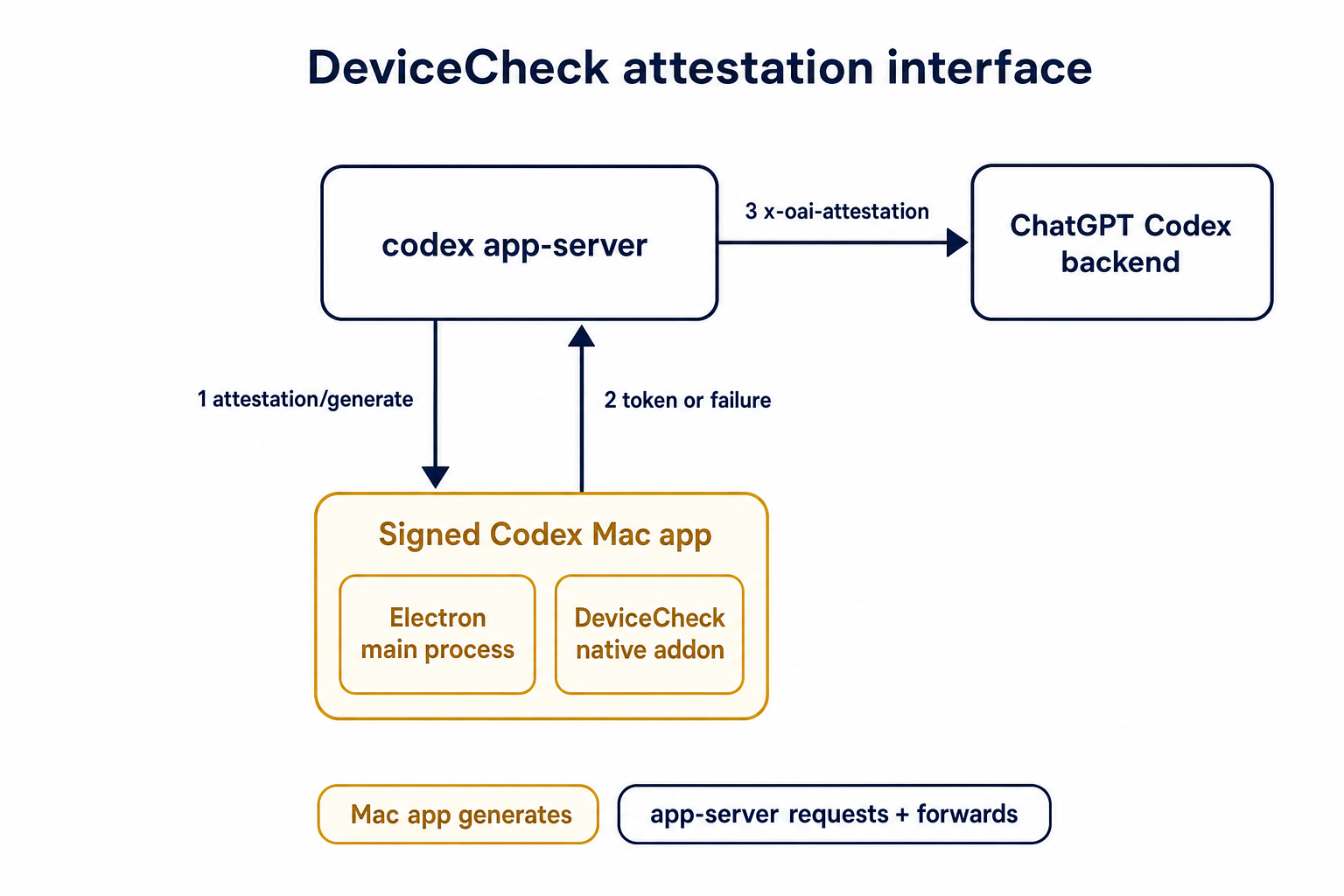
## Details
This PR teaches the Codex app-server runtime how to request and attach
an attestation token. It does not generate DeviceCheck tokens directly;
instead, it relies on the connected desktop app to advertise that it can
generate attestation and then asks that app for a fresh header value
when needed.
The flow is:
1. The Codex desktop app connects to app-server.
2. During `initialize`, the app can advertise that it supports
`requestAttestation`.
3. Before app-server calls selected ChatGPT Codex endpoints, it sends
the internal server request `attestation/generate` to the app.
4. app-server receives a pre-encoded header value back.
5. app-server forwards that value as `x-oai-attestation` on the scoped
outbound requests.
The code in this repo is mostly protocol and runtime plumbing: it adds
the app-server request/response shape, introduces an attestation
provider in core, wires that provider into Responses / compaction /
realtime setup paths, and covers the intended scoping with tests. The
signed macOS DeviceCheck generation remains owned by the desktop app PR.
## Related PR
- Codex desktop app implementation:
https://github.com/openai/openai/pull/878649
## Validation
<details>
<summary>Tests run</summary>
```sh
cargo test -p codex-app-server-protocol
cargo test -p codex-core attestation --lib
cargo test -p codex-app-server --lib attestation
```
Also ran:
```sh
just fix -p codex-core
just fix -p codex-app-server
just fix -p codex-app-server-protocol
just fmt
just write-app-server-schema
```
</details>
<details>
<summary>E2E DeviceCheck validation</summary>
First validated the signed desktop app boundary directly: launched a
packaged signed `Codex.app`, sent `attestation/generate`, decoded the
returned `v1.` attestation header, and validated the extracted
DeviceCheck token with `personal/jm/verify_devicecheck_token.py` using
bundle ID `com.openai.codex`. Apple returned `status_code: 200` and
`is_ok: true`.
Then ran the fuller app + app-server flow. The packaged `Codex.app`
launched a current-branch app-server via `CODEX_CLI_PATH`, and a local
MITM proxy intercepted outbound `chatgpt.com` traffic. The app-server
requested `attestation/generate` from the real Electron app process, and
the intercepted `/backend-api/codex/responses` traffic included
`x-oai-attestation` on both routes:
```text
GET /backend-api/codex/responses Upgrade: websocket x-oai-attestation: present
POST /backend-api/codex/responses Upgrade: none x-oai-attestation: present
```
The captured header decoded to a DeviceCheck token that also validated
with Apple for `com.openai.codex` (`status_code: 200`, `is_ok: true`,
team `2DC432GLL2`).
</details>
---------
Co-authored-by: Codex <noreply@openai.com>
## Summary

The TUI app refactor in #18753 moved the old `app.rs` tests into a
single `app/tests.rs` file. That kept the split mechanically simple, but
it left several focused unit tests far from the modules they exercise.

This PR is a follow-up that moves tests next to the code they cover.

It also adds `tui/src/app/test_support.rs` for shared fixture
construction.

This is just a mechanical refactoring (no functional changes) and does
not affect any production code.
## Summary

Side conversations can hide important state changes from the parent
conversation while the user is focused on the side thread. In
particular, the parent may finish, fail, need user input, or require an
approval while the side conversation remains visible. Users need a
lightweight signal for those states, but parent approval overlays should
not interrupt the side conversation itself.

This change adds parent-conversation status to the side conversation
context label and defers parent interactive overlays while side mode is
active. When the user exits side mode, pending parent approvals and
input requests are restored in the main thread. The pending approval
footer avoids duplicating the same parent approval status, and replayed
notice cells are filtered when restoring a pending interactive request
so tips or warnings do not crowd out the approval prompt.

The change is contained to the TUI side-conversation and thread replay
paths.

Example 1: Approval pending
<img width="752" height="35" alt="Screenshot 2026-04-19 at 12 56 07 PM"
src="https://github.com/user-attachments/assets/1cc0f1a3-9cab-4d60-aed2-96523ccafc20"
/>

Example 2: Turn complete
<img width="754" height="35" alt="Screenshot 2026-04-19 at 12 56 27 PM"
src="https://github.com/user-attachments/assets/653521a5-e298-4366-ae1c-72b56eb88eeb"
/>
The TUI supports long-running turns and agent threads, but quick side
questions have required interrupting the main flow or manually
forking/navigating threads. This PR adds a guarded `/side` flow so users
can ask brief side-conversation questions in an ephemeral fork while
keeping the primary thread focused. This also helps address the feature
request in #18125.

The implementation creates one side conversation at a time, lets `/side`
open either an empty side thread or immediately submit `/side
<question>`, and returns to the parent with Esc or Ctrl+C. Side
conversations get hidden developer guardrails that treat inherited
history as reference-only and steer the model away from workspace
mutations unless explicitly requested in the side conversation.

The TUI hides most slash commands while side mode is active, leaving
only `/copy`, `/diff`, `/mention`, and `/status` available there.
 Eric Traut
