## What changed

Add `userVerification/status`, `userVerification/enroll`, `userVerification/delete`, and `userVerification/verify` behind the `experimentalApi` capability. Define request, response, proof, and typed error contracts, export their schemas, and document the API.

All four methods currently return `unavailable` with reason `providerUnavailable`; native verification operations are not implemented by this change.

## Testing

Add tests for experimental opt-in, typed provider unavailability, readiness serialization, and rejection of mismatched error reasons and native diagnostic payloads.

GitOrigin-RevId: a858ab41523c5acec7dbf3cfa7fcab693ac44a8c
## What changed

- Add `application.network` managed requirements with exact-domain allow/deny
  rules, default-enabled behavior, domain normalization, and normal managed TOML
  precedence.
- Return the policy separately from agent network requirements through the
  experimental `configRequirements/read` API. The endpoint reports the policy
  but does not enforce it.
- Export the new protocol types and schemas, and document the TOML format.

## Testing

- Cover parsing, validation, normalization, layered precedence, and cloud
  requirement composition.
- Verify app-server responses, defaults, separation from agent policy, and
  rejection of invalid domains.

GitOrigin-RevId: 563eeed296d9748430b819797204a44a8db92f3b
## What changed

- Add typed `browser_use` settings for history access and per-origin access,
  download, upload, and full CDP policies.
- Add typed `computer_use` settings for default app access, macOS bundle IDs,
  Windows AUMIDs, and Windows executable identities.
- Expose the merged settings through app-server config reads and generated
  Rust, TypeScript, and JSON schemas.

## Testing

- Cover TOML serialization round trips, layered config reads with origin
  metadata, and app-server batch writes.

GitOrigin-RevId: 78065f6fec990602071fc81ff639ff97f7ad8cd5
## What changed

- Add experimental `account/bedrock/discover` and `account/bedrock/setup`
  requests to the app-server protocol.
- Define discovery results for AWS profiles and environment credentials, plus
  setup inputs for profiles, environment credentials, and access keys.
- Export the new types in the experimental protocol schema. The app server
  currently returns `method not found` for both requests because setup is not
  yet implemented.

GitOrigin-RevId: 656b4bc11231a417e97041068cecc5dc692786e3
## What changed

- Extend `account/usage/read` with an optional `threadId` request and a
  backward-compatible `threadUsage` response containing estimated credits,
  optional USD cost, and model, reasoning, speed, and token breakdowns.
- Fetch thread usage for eligible Business and Enterprise plans when `/status`
  is opened, then update the rendered status card asynchronously.
- Preserve terminal scrollback when replacing a visible status-card tail, and
  append a refreshed card when the original tail can no longer be updated.

## Testing

- Add app-server coverage for authentication, canonical thread IDs,
  unavailable billing routes, and malformed IDs.
- Add TUI coverage for usage formatting, stale responses, retries, history
  updates, terminal reflow, and scrollback preservation.

GitOrigin-RevId: 49300914b3fba917c0f08e8595363e04e5ba6d37
## What changed

- Add the experimental `server/diagnostics` request, returning the app-server process ID, resident memory, platform-dependent physical footprint, and registered diagnostic gauges.
- Export the new protocol types in the generated JSON and TypeScript schemas and document the request.

## Testing

- Verify the response includes process measurements and the registered live-thread gauge.
- Verify the request is rejected unless `capabilities.experimentalApi` is enabled.

GitOrigin-RevId: 099d60a9c421a74ff1a72fe524e0dfeb89cf1057
## What changed

- Add the experimental `plugin/search` request with search term, scope, working-directory, cursor, and limit parameters.
- Define paginated results that include each plugin's marketplace name and optional local marketplace path.
- Route the request through app server while returning method-not-found until the search implementation is available.

## Testing

- Add an app-server test that verifies `plugin/search` returns JSON-RPC error `-32601` with the expected not-implemented message.

GitOrigin-RevId: 755400468331f0887f7da7d933195c347aadf6d0
## What

Server should request:

```
{
  "id": 42,
  "method": "currentTime/read",
  "params": {
    "threadId": "11111111-1111-1111-1111-aaaaafdc2c11"
  }
}
```

Client should respond with something like:

```rust
{
  "id": 42,
  "result": {
    "currentTimeAt": 1781717655
  }
}
```

## Why

Sessions configured with `clock_source = "external"` need a
thread-specific external time source before inference. The system clock
remains the default production provider.

## Validation

- `cargo test -p codex-app-server-protocol`
- `cargo test -p codex-app-server --test all
current_time_read_round_trip_adds_reminder_to_model_input`
- `cargo test -p codex-app-server
first_attestation_capable_connection_for_thread_only_uses_thread_subscribers`
- `cargo test -p codex-analytics`
- `just fix -p codex-app-server-protocol`
- `just fix -p codex-app-server`

Stacked on #28824.
## Summary

Support registry-backed remote executors end to end so downstream
services can resolve an executor id into an exec-server URL and make
that environment available to Codex without relying on the legacy cloud
environments flow.

## What changed

- switch remote executor registration to the executor registry bootstrap
contract
- allow named remote environments to be inserted into
`EnvironmentManager` at runtime
- add the experimental app-server RPC `environment/add` so initialized
experimental clients can register those remote environments for later
`thread/start` and `turn/start` selection

## Validation

Ran focused validation locally:
- `cargo test -p codex-exec-server environment_manager_`
- `cargo test -p codex-exec-server
register_executor_posts_with_bearer_token_header`
- `cargo test -p codex-app-server-protocol`
## Summary
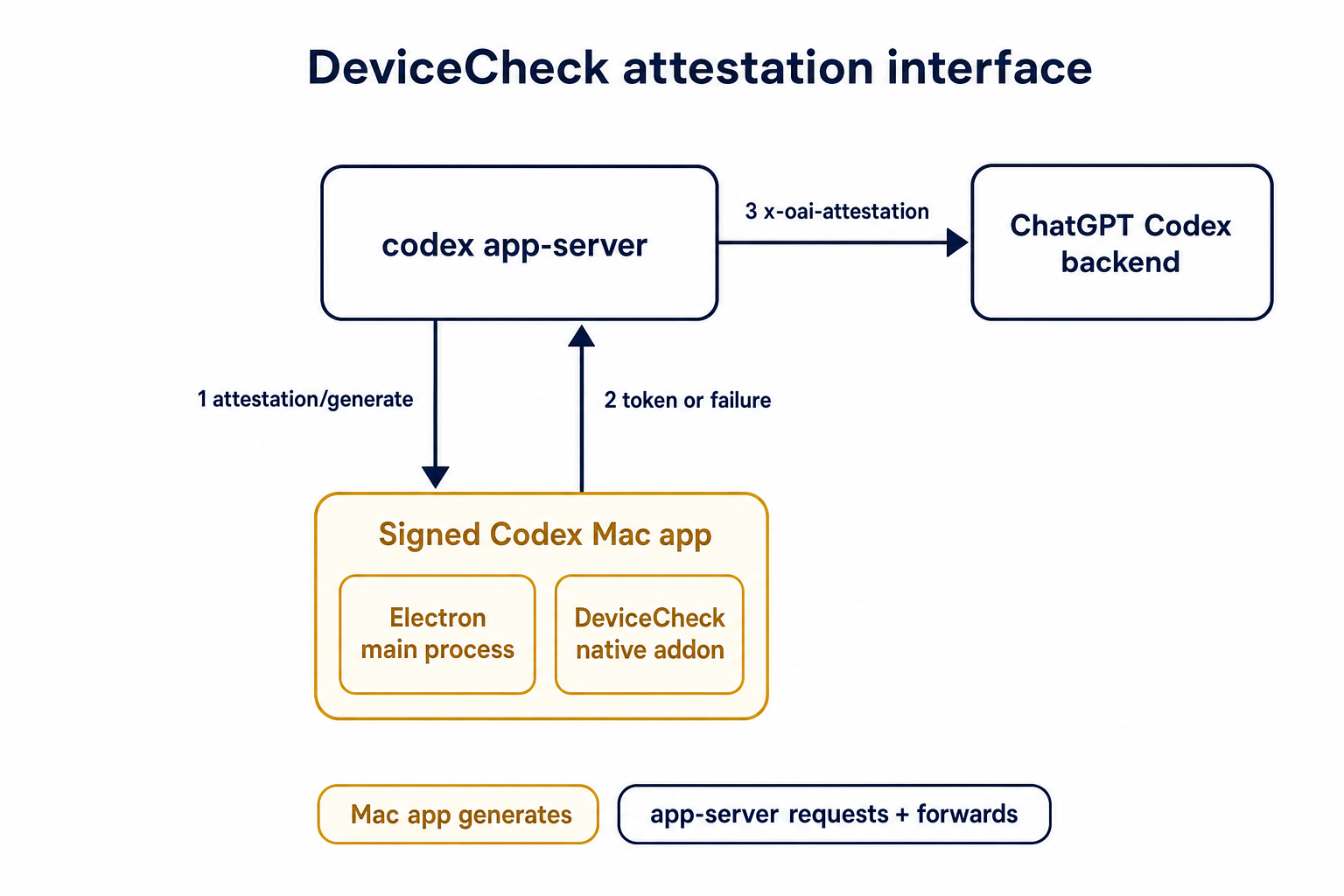
TL;DR: teaches `codex-rs` / app-server to request a desktop-provided
attestation token and attach it as `x-oai-attestation` on the scoped
ChatGPT Codex request paths.
## Details
This PR teaches the Codex app-server runtime how to request and attach
an attestation token. It does not generate DeviceCheck tokens directly;
instead, it relies on the connected desktop app to advertise that it can
generate attestation and then asks that app for a fresh header value
when needed.
The flow is:
1. The Codex desktop app connects to app-server.
2. During `initialize`, the app can advertise that it supports
`requestAttestation`.
3. Before app-server calls selected ChatGPT Codex endpoints, it sends
the internal server request `attestation/generate` to the app.
4. app-server receives a pre-encoded header value back.
5. app-server forwards that value as `x-oai-attestation` on the scoped
outbound requests.
The code in this repo is mostly protocol and runtime plumbing: it adds
the app-server request/response shape, introduces an attestation
provider in core, wires that provider into Responses / compaction /
realtime setup paths, and covers the intended scoping with tests. The
signed macOS DeviceCheck generation remains owned by the desktop app PR.
## Related PR
- Codex desktop app implementation:
https://github.com/openai/openai/pull/878649
## Validation
<details>
<summary>Tests run</summary>
```sh
cargo test -p codex-app-server-protocol
cargo test -p codex-core attestation --lib
cargo test -p codex-app-server --lib attestation
```
Also ran:
```sh
just fix -p codex-core
just fix -p codex-app-server
just fix -p codex-app-server-protocol
just fmt
just write-app-server-schema
```
</details>
<details>
<summary>E2E DeviceCheck validation</summary>
First validated the signed desktop app boundary directly: launched a
packaged signed `Codex.app`, sent `attestation/generate`, decoded the
returned `v1.` attestation header, and validated the extracted
DeviceCheck token with `personal/jm/verify_devicecheck_token.py` using
bundle ID `com.openai.codex`. Apple returned `status_code: 200` and
`is_ok: true`.
Then ran the fuller app + app-server flow. The packaged `Codex.app`
launched a current-branch app-server via `CODEX_CLI_PATH`, and a local
MITM proxy intercepted outbound `chatgpt.com` traffic. The app-server
requested `attestation/generate` from the real Electron app process, and
the intercepted `/backend-api/codex/responses` traffic included
`x-oai-attestation` on both routes:
```text
GET /backend-api/codex/responses Upgrade: websocket x-oai-attestation: present
POST /backend-api/codex/responses Upgrade: none x-oai-attestation: present
```
The captured header decoded to a DeviceCheck token that also validated
with Apple for `com.openai.codex` (`status_code: 200`, `is_ok: true`,
team `2DC432GLL2`).
</details>
---------
Co-authored-by: Codex <noreply@openai.com>
## Why

`codex-rs/app-server-protocol/src/protocol/v2.rs` had grown into a
single ~12k-line definition file for the entire app-server v2 API.

This is purely a mechanical refactor to break up the monolithic `v2.rs`
file that contains all app-server API v2 types into more modular files,
grouped by resource (e.g. account, thread, turn, etc.).

`just write-app-server-schema` shows no real changes, so we can be sure
that this is purely an internal organizational change.

## What changed

- Replaced the monolithic `protocol/v2.rs` with a `protocol/v2/` module
tree and a small `mod.rs` that only declares and reexports modules.
- Grouped v2 API definitions by conceptual owner, including `account`,
`apps`, `collaboration_mode`, `command_exec`, `config`, `device_key`,
`experimental_feature`, `feedback`, `fs`, `hook`, `item`, `mcp`,
`model`, `notification`, `permissions`, `plugin`, `process`, `realtime`,
`review`, `thread`, `thread_data`, `turn`, and `windows_sandbox`.
- Moved v2 tests into `protocol/v2/tests.rs` so `mod.rs` stays small.
- Kept shared protocol helpers in `protocol/v2/shared.rs`, including the
enum mirroring macro and common cross-resource types.
- Co-located resource-specific notifications and server-request payloads
with the modules that own those resources.
- Regenerated app-server protocol schema fixtures. The schema diffs are
non-semantic newline-only changes after the refactor.

## Verification

- `cargo check -p codex-app-server-protocol`
- `cargo test -p codex-app-server-protocol`
- `just write-app-server-schema`
 riley-oai
