## Why

App-server logs can be persisted or included in submitted diagnostics, so credentials used by model providers, authentication refreshes, and attestation requests must not appear in diagnostic output.

## What changed

- Add `RedactedString`, which preserves serialization and string access while replacing debug output with `<redacted>`.
- Use it for model-provider bearer tokens, header and query values, authentication command arguments, and attestation tokens.
- Avoid logging JSON-RPC error payloads and parser or authentication errors that may echo credentials; retain safe context such as error codes and categories.

## Testing

- Add an app-server regression test that exercises provider credentials, refreshed authentication tokens, and attestation tokens, then verifies none appear in persisted SQLite or submitted diagnostic logs.

GitOrigin-RevId: 8c50408adf94d93847658b1320682cf3b637d2cc
## Why

Normal app-server protocol builds do not need the `ts-rs` and `schemars`
implementations used to generate schema exports.

## What changed

- Embed compressed stable and experimental TypeScript and JSON schema exports,
  and serve the existing export APIs from those artifacts.
- Use no-op schema derives in non-test builds while keeping the real generators
  available for fixture regeneration and tests.
- Move schema fixture regeneration behind a Python helper and update
  `just write-app-server-schema --experimental` to refresh the experimental
  embedded exports.

## Testing

- Verify embedded exports match freshly generated stable and experimental
  schemas.
- Verify export options and on-disk output remain compatible.

GitOrigin-RevId: e8536338b457e6eec34bdf29ec0684144bd13734
## Summary
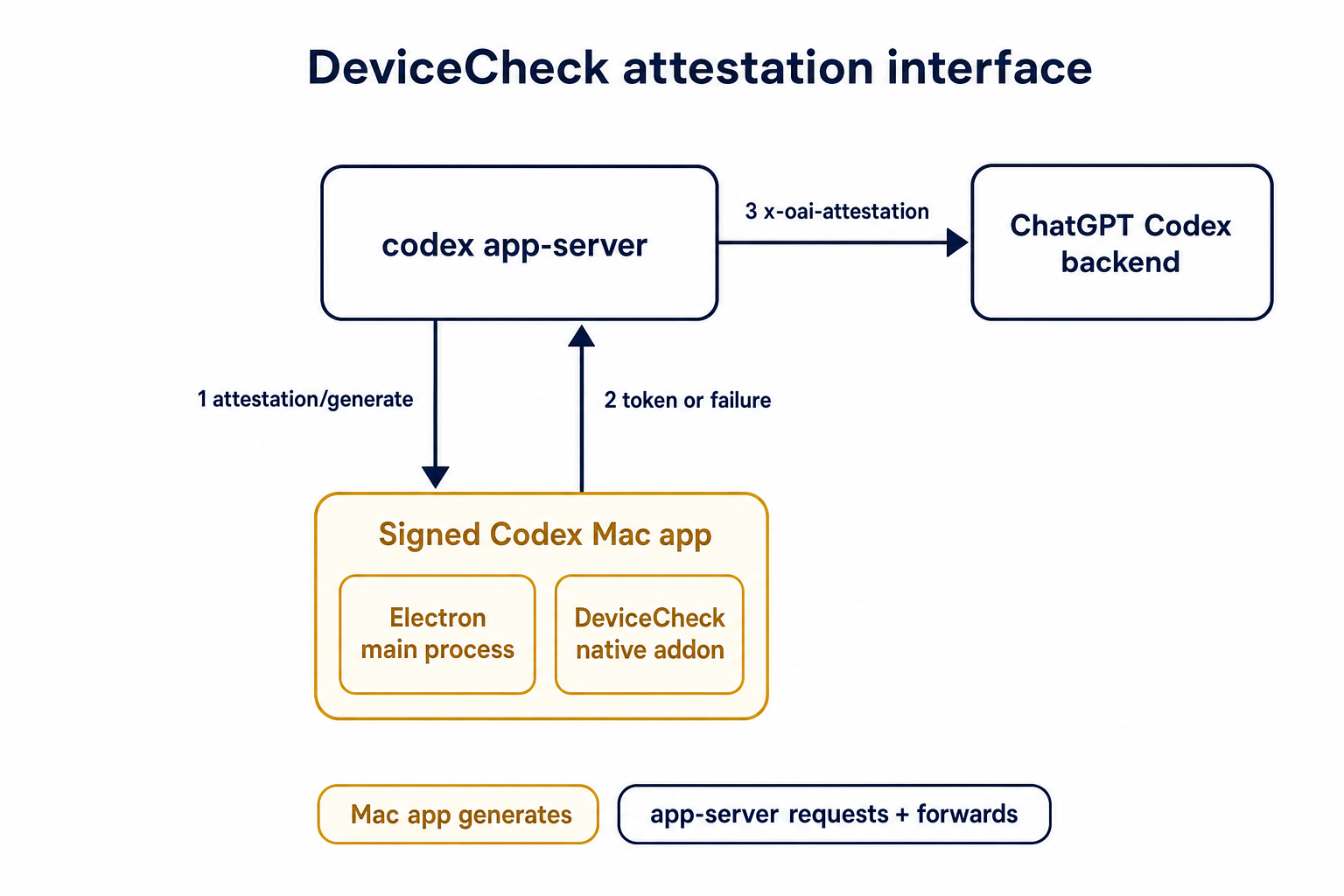
TL;DR: teaches `codex-rs` / app-server to request a desktop-provided
attestation token and attach it as `x-oai-attestation` on the scoped
ChatGPT Codex request paths.
## Details
This PR teaches the Codex app-server runtime how to request and attach
an attestation token. It does not generate DeviceCheck tokens directly;
instead, it relies on the connected desktop app to advertise that it can
generate attestation and then asks that app for a fresh header value
when needed.
The flow is:
1. The Codex desktop app connects to app-server.
2. During `initialize`, the app can advertise that it supports
`requestAttestation`.
3. Before app-server calls selected ChatGPT Codex endpoints, it sends
the internal server request `attestation/generate` to the app.
4. app-server receives a pre-encoded header value back.
5. app-server forwards that value as `x-oai-attestation` on the scoped
outbound requests.
The code in this repo is mostly protocol and runtime plumbing: it adds
the app-server request/response shape, introduces an attestation
provider in core, wires that provider into Responses / compaction /
realtime setup paths, and covers the intended scoping with tests. The
signed macOS DeviceCheck generation remains owned by the desktop app PR.
## Related PR
- Codex desktop app implementation:
https://github.com/openai/openai/pull/878649
## Validation
<details>
<summary>Tests run</summary>
```sh
cargo test -p codex-app-server-protocol
cargo test -p codex-core attestation --lib
cargo test -p codex-app-server --lib attestation
```
Also ran:
```sh
just fix -p codex-core
just fix -p codex-app-server
just fix -p codex-app-server-protocol
just fmt
just write-app-server-schema
```
</details>
<details>
<summary>E2E DeviceCheck validation</summary>
First validated the signed desktop app boundary directly: launched a
packaged signed `Codex.app`, sent `attestation/generate`, decoded the
returned `v1.` attestation header, and validated the extracted
DeviceCheck token with `personal/jm/verify_devicecheck_token.py` using
bundle ID `com.openai.codex`. Apple returned `status_code: 200` and
`is_ok: true`.
Then ran the fuller app + app-server flow. The packaged `Codex.app`
launched a current-branch app-server via `CODEX_CLI_PATH`, and a local
MITM proxy intercepted outbound `chatgpt.com` traffic. The app-server
requested `attestation/generate` from the real Electron app process, and
the intercepted `/backend-api/codex/responses` traffic included
`x-oai-attestation` on both routes:
```text
GET /backend-api/codex/responses Upgrade: websocket x-oai-attestation: present
POST /backend-api/codex/responses Upgrade: none x-oai-attestation: present
```
The captured header decoded to a DeviceCheck token that also validated
with Apple for `com.openai.codex` (`status_code: 200`, `is_ok: true`,
team `2DC432GLL2`).
</details>
---------
Co-authored-by: Codex <noreply@openai.com>
 andrewgu-oai
