mirror of
https://github.com/openai/codex.git
synced 2026-11-27 23:31:09 +00:00
ecfe174d5f344ea9d52bca67cf3c8ebe5ad06dbb
8
Commits
| Author | SHA1 | Message | Date | |
|---|---|---|---|---|
 Eric Traut |
a19d43a40a |
Add app-server thread/delete API (#25018)
## Why Clients can archive and unarchive threads today, but there is no app-server API for permanently removing a thread. Deletion also needs to cover the full session tree: deleting a main thread should remove spawned subagent threads and the related local metadata instead of leaving orphaned rollout files, goals, or subagent state behind. ## What - Adds the v2 `thread/delete` request and `thread/deleted` notification, with the response shape kept consistent with `thread/archive`. - Implements local hard delete for active and archived rollout files. - Deletes the requested thread's state DB row as the commit point, then best-effort cleans associated state including spawned descendants, goals, spawn edges, logs, dynamic tools, and agent job assignments. - Updates app-server API docs and generated protocol schema/TypeScript fixtures. |
||
|
Felipe Coury
|
5a440c03f2 |
fix(tui): scope MCP startup status by thread (#26639)
## Why MCP startup failures from spawned subagents were rendered as global notifications, so a child thread's failure could pollute the visible parent transcript. Routing the notification to the child exposed two related replay problems: session refresh could discard the buffered event, and a newly created child `ChatWidget` did not know the expected MCP server set, which could leave its startup spinner running after every server had settled. MCP startup diagnostics should remain visible in the thread that owns the startup without affecting other transcripts. The protocol also needs to support a future app-scoped MCP lifecycle where startup is not owned by any thread. ## Reported Behavior The [originating Slack report](https://openai.slack.com/archives/C08JZTV654K/p1780604538859939) called out that using subagents could turn MCP startup failures into a wall of yellow CLI warnings because repeated failures were not deduplicated. The intended behavior is for those diagnostics to remain visible once in the thread that owns the startup, without polluting the parent transcript. ## What Changed - add nullable `threadId` ownership to `mcpServer/startupStatus/updated` - populate it from the app-server conversation ID for the current thread-scoped lifecycle and regenerate the protocol schema and TypeScript artifacts - treat a missing or null `threadId` as app-scoped without injecting it into the active chat transcript - route and buffer thread-owned MCP startup notifications by thread in the TUI - preserve buffered MCP startup events across child session refresh - seed expected MCP servers before replaying a thread snapshot so startup reaches its terminal state - suppress an identical repeated failure warning for the same server within one startup round The owning thread still renders the detailed failure and final `MCP startup incomplete (...)` summary. ## How to Test 1. Configure an optional MCP server named `smoke` that exits during initialization. 2. Launch the TUI with multi-agent support enabled. 3. Confirm the main thread's own startup failure renders one detailed `smoke` warning and one incomplete-startup summary. 4. Spawn exactly one subagent. 5. Confirm the parent transcript does not receive the subagent's MCP startup failure. 6. Switch to the subagent thread and confirm it contains exactly one detailed `smoke` failure and one incomplete-startup summary. 7. Confirm the subagent's MCP startup spinner disappears and the thread remains usable. 8. Switch between the parent and subagent and confirm the warnings neither move nor duplicate. Targeted tests: - `just test -p codex-app-server-protocol` - `just test -p codex-app-server thread_start_emits_mcp_server_status_updated_notifications` - `just test -p codex-tui mcp_startup` The parent/child behavior and spinner completion were also exercised manually in tmux. `just argument-comment-lint` was attempted but blocked by an unrelated local Bazel LLVM empty-glob failure; touched Rust callsites were inspected manually. |
||
|
carlc-oai
|
55aa071b17 |
[codex] Forward turn moderation metadata through app-server (#25710)
## Why
First-party backends can supply turn-scoped moderation metadata that
app-server clients need for client-side presentation. Exposing this as
an experimental typed notification lets opted-in clients consume it
without interpreting raw Responses API events.

## What changed
- forward `response.metadata.openai_chatgpt_moderation_metadata` from
Responses API SSE and WebSocket streams as turn-scoped moderation
metadata
- emit the experimental app-server v2 `turn/moderationMetadata`
notification with `{ threadId, turnId, metadata }`
- add app-server integration coverage for the typed moderation metadata
notification

## Testing
- `just test -p codex-core
build_ws_client_metadata_includes_window_lineage_and_turn_metadata`
- `just test -p codex-core` (fails locally: 46 failures and 1 timeout,
primarily missing `test_stdio_server` and shell snapshot timeouts)
- `just test -p codex-app-server-protocol`
- `just test -p codex-app-server
turn_moderation_metadata_emits_typed_notification_v2`
- `just test -p codex-app-server` (fails locally: 792 passed, 10 failed,
and 5 timed out; failures are in existing environment-sensitive tests,
primarily because nested macOS `sandbox-exec` is not permitted)
- `just write-app-server-schema --experimental --schema-root
/tmp/codex-app-server-schema-experimental`
|
||
|
Eric Traut
|
edc48e4612 |
Sync TUI thread settings through app server (#23507)
Builds on #23502. ## Why #23502 adds the app-server `thread/settings/update` API and matching `thread/settings/updated` notification. The TUI already lets users change thread-scoped settings such as model, reasoning effort, service tier, approvals, permissions, personality, and collaboration mode, but those updates need to flow through the app server so embedded and connected clients observe the same thread state. This is a rework (simplification) of PR https://github.com/openai/codex/pull/22510. It has the same functionality, but the underlying `thread/settings/update` api is now simpler in that it no longer returns the effective settings as a response. Now, clients receive the effective settings only through the `thread/settings/updated` notification. ## What Changed This updates the TUI to send `thread/settings/update` whenever those thread-scoped settings change and to treat the RPC response as the authoritative acknowledgement. It also routes `thread/settings/updated` notifications back into cached session state and the visible chat widget so active and inactive threads stay in sync after app-server-originated changes. The implementation is kept to the TUI layer: settings conversion and merge logic live under `codex-rs/tui/src/app/thread_settings.rs`, with dispatch/routing hooks in the existing app and chat widget paths. ## Verification I manually tested using `codex app-server --listen unix://` and then launching two copies of the TUI that use the same local app server. I then resumed the same thread on both and verified that changes like plan mode, fast mode, model, reasoning effort, etc. are reflected "live" in the second client when modified in the first and vice versa. |
||
|
Eric Traut
|
771a4e74ac |
Add thread/settings/update app-server API (#23502)
## Why App-server clients need a way to update a thread's next-turn settings without starting a turn, adding transcript content, or waiting for turn lifecycle events. This gives settings UI a direct path for durable thread settings while clients observe the eventual effective state through a notification. This is a simplified rework of PR https://github.com/openai/codex/pull/22509. In particular, it changes the `thread/settings/update` api to return immediately rather than waiting and returning the effective (updated) thread settings. This makes the new api consistent with `turn/start` and greatly reduces the complexity of the implementation relative to the earlier attempt. ## What Changed - Adds experimental `thread/settings/update` with partial-update request fields and an empty acknowledgment response. - Adds experimental `thread/settings/updated`, carrying full effective `ThreadSettings` and scoped by `threadId` to subscribed clients for the affected thread. - Shares durable settings validation with `turn/start`, including `sandboxPolicy` plus `permissions` rejection and `serviceTier: null` clearing. - Emits the same settings notification when `turn/start` overrides change the stored effective thread settings. - Regenerates app-server protocol schema fixtures and updates `app-server/README.md`. |
||
|
Jiaming ZhangandCodex
|
5f4d0ec343 |
[codex] request desktop attestation from app (#20619)
## Summary TL;DR: teaches `codex-rs` / app-server to request a desktop-provided attestation token and attach it as `x-oai-attestation` on the scoped ChatGPT Codex request paths. 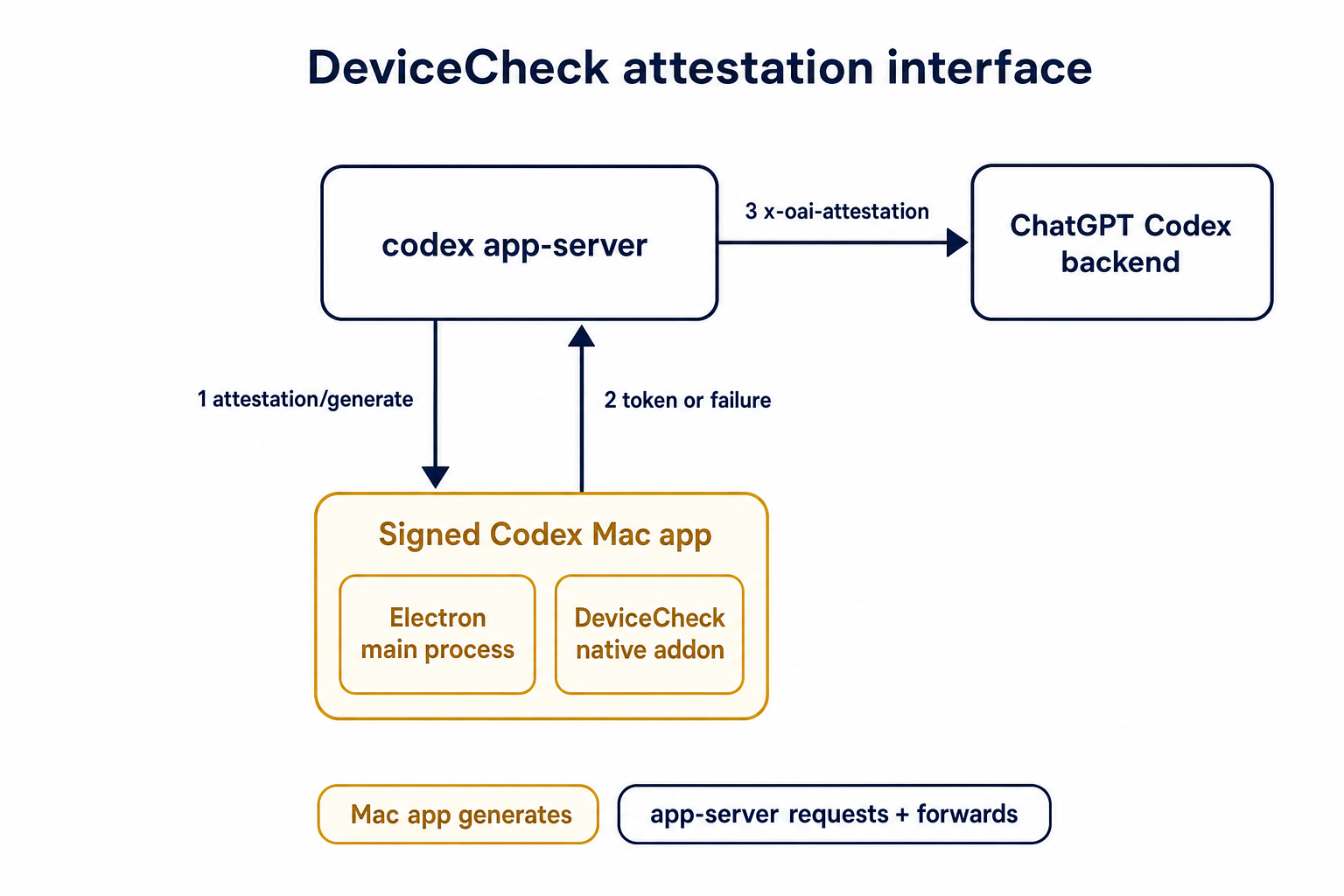 ## Details This PR teaches the Codex app-server runtime how to request and attach an attestation token. It does not generate DeviceCheck tokens directly; instead, it relies on the connected desktop app to advertise that it can generate attestation and then asks that app for a fresh header value when needed. The flow is: 1. The Codex desktop app connects to app-server. 2. During `initialize`, the app can advertise that it supports `requestAttestation`. 3. Before app-server calls selected ChatGPT Codex endpoints, it sends the internal server request `attestation/generate` to the app. 4. app-server receives a pre-encoded header value back. 5. app-server forwards that value as `x-oai-attestation` on the scoped outbound requests. The code in this repo is mostly protocol and runtime plumbing: it adds the app-server request/response shape, introduces an attestation provider in core, wires that provider into Responses / compaction / realtime setup paths, and covers the intended scoping with tests. The signed macOS DeviceCheck generation remains owned by the desktop app PR. ## Related PR - Codex desktop app implementation: https://github.com/openai/openai/pull/878649 ## Validation <details> <summary>Tests run</summary> ```sh cargo test -p codex-app-server-protocol cargo test -p codex-core attestation --lib cargo test -p codex-app-server --lib attestation ``` Also ran: ```sh just fix -p codex-core just fix -p codex-app-server just fix -p codex-app-server-protocol just fmt just write-app-server-schema ``` </details> <details> <summary>E2E DeviceCheck validation</summary> First validated the signed desktop app boundary directly: launched a packaged signed `Codex.app`, sent `attestation/generate`, decoded the returned `v1.` attestation header, and validated the extracted DeviceCheck token with `personal/jm/verify_devicecheck_token.py` using bundle ID `com.openai.codex`. Apple returned `status_code: 200` and `is_ok: true`. Then ran the fuller app + app-server flow. The packaged `Codex.app` launched a current-branch app-server via `CODEX_CLI_PATH`, and a local MITM proxy intercepted outbound `chatgpt.com` traffic. The app-server requested `attestation/generate` from the real Electron app process, and the intercepted `/backend-api/codex/responses` traffic included `x-oai-attestation` on both routes: ```text GET /backend-api/codex/responses Upgrade: websocket x-oai-attestation: present POST /backend-api/codex/responses Upgrade: none x-oai-attestation: present ``` The captured header decoded to a DeviceCheck token that also validated with Apple for `com.openai.codex` (`status_code: 200`, `is_ok: true`, team `2DC432GLL2`). </details> --------- Co-authored-by: Codex <noreply@openai.com> |
||
|
Ruslan NigmatullinandOwen Lin
|
4950e7d8a6 |
[codex] Add unsandboxed process exec API (#19040)
## Why App-server clients sometimes need argv-based local process execution while sandbox policy is controlled outside Codex. Those environments can reject sandbox-disabling paths before a command ever starts, even when the caller intentionally wants unsandboxed execution. This PR adds a distinct `process/*` API for that use case instead of extending `command/exec` with another sandbox-disabling shape. Keeping the new surface separate also makes the future removal of `command/exec` simpler: clients that need explicit process lifecycle control can move to the newer handle-based API without depending on `command/exec` business logic. ## What changed - Added v2 process lifecycle methods: `process/spawn`, `process/writeStdin`, `process/resizePty`, and `process/kill`. - Added process notifications: `process/outputDelta` for streamed stdout/stderr chunks and `process/exited` for final exit status and buffered output. - Made `process/spawn` intentionally unsandboxed and omitted sandbox-selection fields such as `sandboxPolicy` and `permissionProfile`. - Added client-supplied, connection-scoped `processHandle` values for follow-up control requests and notification routing. - Supported cwd, environment overrides, PTY mode and size, stdin streaming, stdout/stderr streaming, per-stream output caps, and timeout controls. - Killed active process sessions when the originating app-server connection closes. - Wired the implementation through the modular `request_processors/` app-server layout, with process-handle request serialization for follow-up control calls. - Updated generated JSON/TypeScript schema fixtures and documented the new API in `codex-rs/app-server/README.md`. - Added v2 app-server integration coverage in `codex-rs/app-server/tests/suite/v2/process_exec.rs` for spawn acknowledgement before exit, buffered output caps, and process termination. ## Verification - `cargo test -p codex-app-server-protocol` - `cargo test -p codex-app-server` --------- Co-authored-by: Owen Lin <owen@openai.com> |
||
|
Eric Traut
|
c70cdc108f |
Remove core protocol dependency [1/2] (#20324)
## Why This stack moves `codex-tui` away from the core protocol event surface and toward app-server API shapes plus TUI-owned local models. This first PR sets up the lower-risk foundation: it introduces the local model surface and extracts app-server event routing into focused TUI modules while preserving the existing behavior for the larger migration in PR2. This PR is part 1 of a 2-PR stack: 1. Add TUI-owned replacement models and extract app-server event routing. 2. Move the active TUI flow to app-server notifications and delete obsolete adapter code. ## What changed - Added TUI-owned approval, diff, session state, session resume, token usage, and user-message models. - Added `app/app_server_event_targets.rs` and `app/app_server_events.rs` to hold app-server event targeting and dispatch logic outside `app.rs`. - Updated app/status tests to use the local model layer and added focused routing coverage. - Boxed a few large async TUI test futures so this base layer remains checkable without overflowing the default test stack. ## Verification - `cargo check -p codex-tui --tests` |
