The token a request authenticated with now lives on the doer, so
permission and visibility checks apply its scope from the doer alone.
Replaces https://github.com/go-gitea/gitea/pull/39167, following
https://github.com/go-gitea/gitea/pull/39167#issuecomment-6063839619.

1. Public-only tokens get 404 instead of 403 for hidden users, orgs and
repos, like GitHub.
2. Org ownership, site admin, repo and org creation, generation and
transfer endpoints reject public-only tokens.
3. API pull request responses set `head.repo` to `null` and
`head.repo_id` to `-1` when the caller cannot see the head repository.
4. Public-only tokens see org memberships like anonymous callers, so
concealed members stay hidden.
5. Site admin access in activity feeds, follower lists, org members,
Actions run lists and packages needs a session or an `all`-scoped token.

Co-authored-by: wxiaoguang <wxiaoguang@gmail.com>
1. In dev mode, discover themes from source files in
`web_src/css/themes/` instead of AssetFS. In prod, use AssetFS only.
Extract shared `collectThemeFiles` helper to deduplicate theme file
handling.
2. Implement `fs.ReadDirFS` on `LayeredFS` to support theme file
discovery.
3. `IsViteDevMode` now performs an HTTP health check against the vite
dev server instead of only checking the port file exists. Result is
cached with a 1-second TTL.
4. Refactor theme caching from mutex to atomic pointer with time-based
invalidation, allowing themes to refresh when vite dev mode state
changes.
5. Move `ViteDevMiddleware` into `ProtocolMiddlewares` so it applies to
both install and web routes.
6. Show a `ViteDevMode` label in the page footer when vite dev server is
active.
7. Add `/__vite_dev_server_check` endpoint to vite dev server for the
health check.
8. Ensure `.vite` directory exists before writing the dev-port file.
9. Minor CSS fixes: footer gap, navbar mobile alignment.

---
This PR was written with the help of Claude Opus 4.6

---------

Signed-off-by: silverwind <me@silverwind.io>
Co-authored-by: Claude (Opus 4.6) <noreply@anthropic.com>
Co-authored-by: wxiaoguang <wxiaoguang@gmail.com>
Introduce RequestContext: is a short-lived context that is used to store
request-specific data.

RequestContext could be used to clean form tmp files, close context git
repo, and do some tracing in the future.

Then a lot of legacy code could be removed or improved. For example:
most `ctx.Repo.GitRepo.Close()` could be removed because the git repo
could be closed when the request is done.
1. The "web" package shouldn't depends on "modules/context" package,
instead, let each "web context" register themselves to the "web"
package.
2. The old Init/Free doesn't make sense, so simplify it
* The ctx in "Init(ctx)" is never used, and shouldn't be used that way
* The "Free" is never called and shouldn't be called because the SSPI
instance is shared

---------

Co-authored-by: Giteabot <teabot@gitea.io>
Partially for #24457
Major changes:
1. The old `signedUserNameStringPointerKey` is quite hacky, use
`ctx.Data[SignedUser]` instead
2. Move duplicate code from `Contexter` to `CommonTemplateContextData`
3. Remove incorrect copying&pasting code `ctx.Data["Err_Password"] =
true` in API handlers
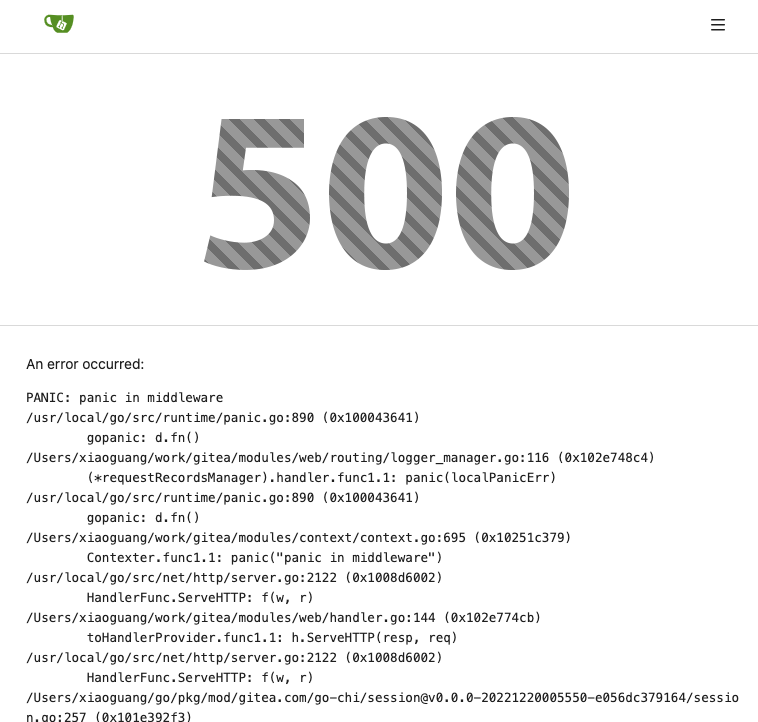
4. Use one unique `RenderPanicErrorPage` for panic error page rendering
5. Move `stripSlashesMiddleware` to be the first middleware
6. Install global panic recovery handler, it works for both `install`
and `web`
7. Make `500.tmpl` only depend minimal template functions/variables,
avoid triggering new panics
Screenshot:
<details>
</details>
Change all license headers to comply with REUSE specification.
Fix#16132
Co-authored-by: flynnnnnnnnnn <flynnnnnnnnnn@github>
Co-authored-by: John Olheiser <john.olheiser@gmail.com>

