 fufesou
350966b331
* fix: secure trusted devices with host-issued V2 tokens

Signed-off-by: fufesou <linlong1266@gmail.com>

* fix: preserve trusted-device management and ordinary authentication

Restore selected-device deletion using nonsecret record identifiers and acknowledged V2 revocation errors.

Preserve password and TOTP authentication when the V2 authority or cached controller credentials are unavailable. Disable V2 for the affected attempt while retaining authentication, configuration, and revocation rejection.

Validation: 20 selected Rust tests, Flutter-feature Rust compilation, focused Dart analysis, formatting, and whitespace checks passed.
Signed-off-by: fufesou <linlong1266@gmail.com>

* fix: simplify trusted-device caching and stabilize tests

Signed-off-by: fufesou <linlong1266@gmail.com>

* fix: persist trusted-device grants in host configuration

Store host grants in RustDesk2.toml and preserve revocation across configuration writes and service transitions. Use local authority on macOS when no background service is installed.

Preserve both configuration imports by checking Config2 eligibility before revocation writes. Cover the password and 2FA import regression alongside the existing trusted-device tests.

Signed-off-by: fufesou <linlong1266@gmail.com>

* fix: store trusted-device credentials in peer configuration

Signed-off-by: fufesou <linlong1266@gmail.com>

* fix: minimize trusted-device persistence changes

Signed-off-by: fufesou <linlong1266@gmail.com>

* refactor: minimize trusted-device integration changes

Keep ordinary policy writes on the generic configuration path and document authentication updates. Restore the macOS installer to master, rename the V2 version gate, and relocate the existing client regression test.

Signed-off-by: fufesou <linlong1266@gmail.com>

* fix: harden trusted-device revocation and persistence

Recover corrupt grant data without skipping authentication-write validation, and avoid revoking trust when IPC synchronizes an unchanged salt. Make desktop management IPC async and keep runtime creation at the Flutter worker boundary.

Update hbb_common to preserve V2 credentials when configuration reads fail, and extend existing regressions for clear, salt synchronization, and persistence failures.

Signed-off-by: fufesou <linlong1266@gmail.com>

* fix: preserve trusted-device validation and no-op settings

Validate trust before connection side effects and retain tickets for the final check when the authority is unavailable after TOTP. Disable enrollment on that path.

Skip revocation for password operations that the existing setter treats as no-ops, extend the existing IPC regression, and clean up client state on initialization or credential errors.

Validation: 36 targeted native tests, Flutter-feature Rust check, formatting, and git diff --check passed.
Signed-off-by: fufesou <linlong1266@gmail.com>

* feat: add trusted-device expiry and per-device renewal

Keep legacy records for password-and-TOTP migration, encrypt host grant storage, and add configurable trust periods that revoke grants when changed. Allow renewing individual unexpired devices from the manager, hide renewal for never-expiring grants, and preserve the mobile table height constraints.

Signed-off-by: fufesou <linlong1266@gmail.com>

* fix(macos): report trusted-device cleanup failure before uninstall

Revoke local trusted-device grants before dispatching the uninstall closure so cleanup failures return false without starting the uninstall script. Keep the existing synchronous and asynchronous script execution paths.

Signed-off-by: fufesou <linlong1266@gmail.com>

* fix: preserve trusted-device settings and revoke macOS service grants

Default unsupported expiration values on read while keeping explicit edits strict. Allow password/TOTP when stored grants are out of sync, after validating the authentication scope.

Revoke root-owned grants during macOS service removal. Bump hbb_common for malformed-file recovery and legacy-record preservation, and retain the reviewed regression coverage.

Signed-off-by: fufesou <linlong1266@gmail.com>

* fix: avoid duplicate trusted-device revocation during config sync

Signed-off-by: fufesou <linlong1266@gmail.com>

* fix: preserve trusted-device revocation during config mismatches

Allow grant clearing when authentication snapshots are unavailable and validate existing snapshots before applying authentication updates. Restore optimistic caching for non-auth bulk options and restrict the trusted-device IPC helper to desktop targets.

Signed-off-by: fufesou <linlong1266@gmail.com>

* feat: preserve trusted devices when trust duration changes

Adjust existing grant deadlines for duration changes and startup policy overrides, support 90 days, and use an adaptive inline duration selector without the obsolete revocation warning.

Consolidate management IPC and trim redundant tests while retaining authentication and revocation coverage.

Validation: four existing focused Rust tests and the startup override reproduction passed; Windows default/service and Flutter-feature cargo checks passed.
Signed-off-by: fufesou <linlong1266@gmail.com>

* fix: finish trusted-device notice cleanup and duration sync

Remove the recurring legacy notice, unused response metadata and translation key. Allow duration-only saves with a readable inactive grant scope while preserving storage and authentication errors.

Update hbb_common to 040bf3f662ae7422f2f9570701cc8451f7bb1d59, which removes the unused legacy detector.

Validation: four existing focused Rust tests passed; Windows default/service and Flutter-feature cargo checks passed. No new tests were added.
Signed-off-by: fufesou <linlong1266@gmail.com>

* fix: refine trusted-device duration layout

Indent the duration row beneath the trusted-device option, add vertical spacing, and compact the desktop selector. Mobile sizing and other dropdowns remain unchanged.

Validation: targeted Dart analysis passed with existing informational diagnostics. Actual window rendering was not exercised.
Signed-off-by: fufesou <linlong1266@gmail.com>

* refact: adjust indentation

Signed-off-by: fufesou <linlong1266@gmail.com>

* fix: preserve trusted devices across version upgrades

Honor existing legacy trust without creating new legacy registrations. Import live records into encrypted grants, apply the current expiration policy, and migrate consenting controllers to V2 tokens while retaining grouped revocation.

Advertise V2 capability explicitly and hide enrollment for mixed-version sessions. Update existing coverage and use the paired hbb_common migration API.

Signed-off-by: fufesou <linlong1266@gmail.com>

* fix: translations

Signed-off-by: fufesou <linlong1266@gmail.com>

* Align the compact trusted-device duration selector on mobile

Signed-off-by: fufesou <linlong1266@gmail.com>

* Default trusted devices to 90 days and drop unreleased V2 migrations

Signed-off-by: fufesou <linlong1266@gmail.com>

* Avoid masking macOS daemon stop failures during uninstall

Signed-off-by: fufesou <linlong1266@gmail.com>

* restore uninstall.scpt, do not clear trusted devices on uninstall

Signed-off-by: fufesou <linlong1266@gmail.com>

* Preserve trusted devices when uninstalling services

Signed-off-by: fufesou <linlong1266@gmail.com>

* Preserve trusted devices when importing host configuration

Signed-off-by: fufesou <linlong1266@gmail.com>

* Recover from unreadable trusted-device grants

Log and persistently revoke invalid or undecryptable V2 payloads so password and TOTP can enroll a new device. Keep configuration read and write errors explicit and extend existing tests to cover recovery and rejection of old tokens.

Signed-off-by: fufesou <linlong1266@gmail.com>

* Preserve trusted devices across service transitions

Run grant operations in the accepting server and synchronize current grants and revocations through the existing service configuration channel. Keep ordinary settings saves from restoring stale credentials and retain root peer verification.

Recognize explicit configuration errors as live service responses during IPC probing, so duplicate startup does not remove the active socket.

Validated with five trusted-device tests, seven Linux IPC filesystem tests, an isolated IPC regression probe, and Windows Flutter and Linux compilation checks. Installed-service transitions and macOS runtime behavior remain untested.

Signed-off-by: fufesou <linlong1266@gmail.com>

* Keep trusted-device grants under the service authority

Preserve root-owned grants when copying service configuration and route installed-host trust operations through the root service. Keep local authentication edits available when the Linux service is explicitly stopped, then synchronize pending revocation before using service grants.

Serialize pending revocation synchronization and cover service copies, stale user snapshots, and stopped-service authentication updates with the existing focused tests.

Signed-off-by: fufesou <linlong1266@gmail.com>

* Replace same-ID grants when enrolling trusted devices

Signed-off-by: fufesou <linlong1266@gmail.com>

* Allow macOS security edits after service removal

Reuse pending trusted-device revocation for offline password and 2FA changes. Honor pending revocation during installation copies and before root-authority requests and configuration synchronization.

Validation: five focused macOS tests, macOS and Windows cargo checks, and targeted formatting checks.
Signed-off-by: fufesou <linlong1266@gmail.com>

* Allow macOS security edits before daemon reinstallation

Detect an absent daemon using retained service ownership instead of the incoming-connections stop flag. General Start resumes connections without reinstalling the daemon, so local authentication edits must continue using pending revocation until installation.

Adjust the existing recovery test to check that toggling incoming connections does not make a standalone profile service-owned.

Signed-off-by: fufesou <linlong1266@gmail.com>

* Allow re-enrollment after invalid controller credentials

Ignore malformed or undecryptable stored token payloads with a throttled warning while preserving file access errors and host identity checks. Fresh authorized enrollment can replace the unusable credential.

Restore logged, non-propagating IPC errors for non-authentication option changes and extend the existing credential recovery test.

Signed-off-by: fufesou <linlong1266@gmail.com>

* Update hbb_common to serialize peer deletion

Signed-off-by: fufesou <linlong1266@gmail.com>

* fix(macos): preserve trusted devices across service removal

Hand off the current root grant store to the removing user and restore that user's latest grants on reinstallation. Keep other retained profiles from becoming authoritative, and preserve user settings when the service has no optional configuration.

Validate the macOS build, five trusted-device tests, isolated headless transfer cases, and AppleScript syntax. Real privileged service transitions remain untested.

Signed-off-by: fufesou <linlong1266@gmail.com>

* refactor(trusted-devices): use local grants and existing config sync

Keep grant decisions in the accepting host process and transfer grants and removals through the existing background configuration sync. Remove root-only grant RPC, ownership handoff, pending revocation, and dedicated copy commands; restore the master service lifecycle on Linux and macOS.

Preserve V2 credentials, authentication revocation, and ordinary-save protections. Accept the existing asynchronous sync and multiple-user limitations.

Validated Windows and macOS Flutter checks, the Linux library/tests/service check, four macOS trusted-device tests, and AppleScript syntax. Real service transitions remain untested.

Signed-off-by: fufesou <linlong1266@gmail.com>

* fix(trusted-devices): preserve migrated tokens at capacity

Raise the shared V2 token limit to 128 and order newly migrated tokens by issuance time without extending their legacy expiration. Extend the existing migration regression coverage to verify token reuse and expiry preservation at capacity.

Signed-off-by: fufesou <linlong1266@gmail.com>

* fix(windows): preserve trust across service stop and start

Export current on-disk grants and explicitly synchronize them into the GUI configuration at startup and before stopping a running service. Abort the stop if synchronization fails so the next service import cannot use a stale local copy.

Extend the existing synchronization regression coverage to check revoked, retained and newly enrolled devices and the actual import-source file. Remove unrelated import logging changes.

Validation: trusted-device tests passed on Windows and macOS (4 each); changed-line formatting and git diff --check passed. Real Windows GUI/UAC service transitions remain untested.
Signed-off-by: fufesou <linlong1266@gmail.com>

* refactor(trusted-devices): simplify local authorization

Replace local authorization envelopes with typed operations while retaining locked authentication checks and persistence. Remove redundant configuration and Dart wrappers without changing credential formats or management requests.

Signed-off-by: fufesou <linlong1266@gmail.com>

* fix(windows): allow service removal when host is unavailable

Signed-off-by: fufesou <linlong1266@gmail.com>

* fix(windows): preserve trust revocations before full uninstall

Signed-off-by: fufesou <linlong1266@gmail.com>

* fix(windows): sync trust changes to the retained user config

Signed-off-by: fufesou <linlong1266@gmail.com>

* fix(windows): sync trust after security setting changes

Signed-off-by: fufesou <linlong1266@gmail.com>

---------

Signed-off-by: fufesou <linlong1266@gmail.com>

Build •
Docker •
Structure •
Screenshots
[Українська] | [česky] | [中文] | [Magyar] | [Español] | [فارسی] | [Français] | [Deutsch] | [Polski] | [Indonesian] | [Suomi] | [മലയാളം] | [日本語] | [Nederlands] | [Italiano] | [Русский] | [Português (Portugal)] | [Português (Brasil)] | [Esperanto] | [한국어] | [العربي] | [Tiếng Việt] | [Dansk] | [Ελληνικά] | [Türkçe] | [Norsk] | [Română]
We need your help to translate this README, RustDesk UI and RustDesk Doc to your native language
Caution
Misuse Disclaimer:
The developers of RustDesk do not condone or support any unethical or illegal use of this software. Misuse, such as unauthorized access, control or invasion of privacy, is strictly against our guidelines. The authors are not responsible for any misuse of the application.
Chat with us: Discord | Twitter | Reddit | YouTube

Yet another remote desktop solution, written in Rust. Works out of the box with no configuration required. You have full control of your data, with no concerns about security. You can use our rendezvous/relay server, set up your own, or write your own rendezvous/relay server.
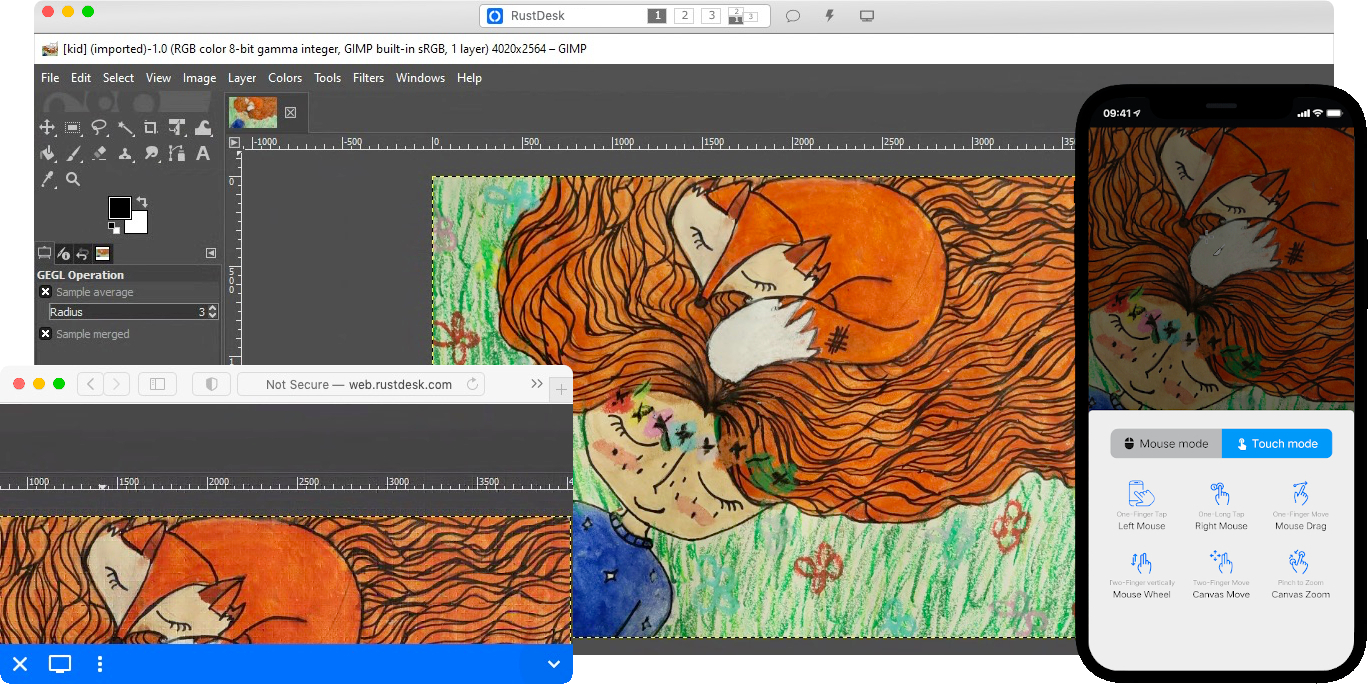
RustDesk welcomes contribution from everyone. See CONTRIBUTING.md for help getting started.

Dependencies
Desktop versions use Flutter or Sciter (deprecated) for GUI. This tutorial is for Sciter only, since it is easier and more friendly to start. Check out our CI for building the Flutter version.
Please download Sciter dynamic library yourself.
Raw Steps to build
-
Prepare your Rust development env and C++ build env
-
Install vcpkg, and set
VCPKG_ROOTenv variable correctly- Windows: vcpkg install libvpx:x64-windows-static libyuv:x64-windows-static opus:x64-windows-static aom:x64-windows-static
- Linux/macOS: vcpkg install libvpx libyuv opus aom
-
run
cargo run
Build
How to Build on Linux
Ubuntu 18 (Debian 10)
sudo apt install -y zip g++ gcc git curl wget nasm yasm libgtk-3-dev clang libxcb-randr0-dev libxdo-dev \
        libxfixes-dev libxcb-shape0-dev libxcb-xfixes0-dev libasound2-dev libpulse-dev cmake make \
        libclang-dev ninja-build libgstreamer1.0-dev libgstreamer-plugins-base1.0-dev
openSUSE Tumbleweed
sudo zypper install gcc-c++ git curl wget nasm yasm gcc gtk3-devel clang libxcb-devel libXfixes-devel cmake alsa-lib-devel gstreamer-devel gstreamer-plugins-base-devel xdotool-devel
Fedora 28 (CentOS 8)
sudo yum -y install gcc-c++ git curl wget nasm yasm gcc gtk3-devel clang libxcb-devel libxdo-devel libXfixes-devel pulseaudio-libs-devel cmake alsa-lib-devel gstreamer1-devel gstreamer1-plugins-base-devel
Arch (Manjaro)
sudo pacman -Syu --needed unzip git cmake gcc curl wget yasm nasm zip make pkg-config clang gtk3 xdotool libxcb libxfixes alsa-lib pipewire
Install vcpkg
git clone https://github.com/microsoft/vcpkg
cd vcpkg
git checkout 2023.04.15
cd ..
vcpkg/bootstrap-vcpkg.sh
export VCPKG_ROOT=$HOME/vcpkg
vcpkg/vcpkg install libvpx libyuv opus aom
Fix libvpx (For Fedora)
cd vcpkg/buildtrees/libvpx/src
cd *
./configure
sed -i 's/CFLAGS+=-I/CFLAGS+=-fPIC -I/g' Makefile
sed -i 's/CXXFLAGS+=-I/CXXFLAGS+=-fPIC -I/g' Makefile
make
cp libvpx.a $HOME/vcpkg/installed/x64-linux/lib/
cd
Build
curl --proto '=https' --tlsv1.2 -sSf https://sh.rustup.rs | sh
source $HOME/.cargo/env
git clone --recurse-submodules https://github.com/rustdesk/rustdesk
cd rustdesk
mkdir -p target/debug
wget https://raw.githubusercontent.com/c-smile/sciter-sdk/master/bin.lnx/x64/libsciter-gtk.so
mv libsciter-gtk.so target/debug
VCPKG_ROOT=$HOME/vcpkg cargo run
How to build with Docker
Begin by cloning the repository and building the Docker container:
git clone https://github.com/rustdesk/rustdesk
cd rustdesk
git submodule update --init --recursive
docker build -t "rustdesk-builder" .
Then, each time you need to build the application, run the following command:
docker run --rm -it -v $PWD:/home/user/rustdesk -v rustdesk-git-cache:/home/user/.cargo/git -v rustdesk-registry-cache:/home/user/.cargo/registry -e PUID="$(id -u)" -e PGID="$(id -g)" rustdesk-builder
Note that the first build may take longer before dependencies are cached, subsequent builds will be faster. Additionally, if you need to specify different arguments to the build command, you may do so at the end of the command in the <OPTIONAL-ARGS> position. For instance, if you wanted to build an optimized release version, you would run the command above followed by --release. The resulting executable will be available in the target folder on your system, and can be run with:
target/debug/rustdesk
Or, if you're running a release executable:
target/release/rustdesk
Please ensure that you run these commands from the root of the RustDesk repository, or the application may not find the required resources. Also note that other cargo subcommands such as install or run are not currently supported via this method as they would install or run the program inside the container instead of the host.
File Structure
- libs/hbb_common: video codec, config, tcp/udp wrapper, and some other utility functions shared with the server
- libs/base: protobuf, fs functions for file transfer, keyboard and platform code used only by this app
- libs/scrap: screen capture
- libs/enigo: platform specific keyboard/mouse control
- libs/clipboard: file copy and paste implementation for Windows, Linux, macOS.
- src/ui: obsolete Sciter UI (deprecated)
- src/server: audio/clipboard/input/video services, and network connections
- src/client.rs: start a peer connection
- src/rendezvous_mediator.rs: Communicate with rustdesk-server, wait for remote direct (TCP hole punching) or relayed connection
- src/platform: platform specific code
- flutter: Flutter code for desktop and mobile