 Mariano Abad
49a9574f97
* fix(drm): pace the producer to the rate the encoder takes, with the panel refresh as floor

The root producer slept a fixed 33 ms after every grab, so every DRM stream topped
out at 30 fps whatever the client asked (rustdesk#16175). Measured on a
1920x1080@60 i915 box with the client at Custom 60 and QoS settled at 60: 30
grabs, 30 converted, 29.8 sent. A shorter fixed interval reaches the rate but
oversamples: at 8 ms the same box grabbed and converted 117/s for 60 sent.

The consumer now tells the producer the rate it encodes at, in the ack byte it
already sends per converted frame: 0x01 as before, or 0x80|fps. Every producer
counts ack bytes and never read their value, so an older service sees exactly
the same credit and keeps its 33 ms; the JSON handshake and the ack count and
timing do not change. The rate is the encoder's spf (what frame() is called
with), lowered to what the encoder achieves when it is busy longer than spf per
frame: the time from one frame() call to the next, less what the call spent
waiting for a frame, so a late producer cannot talk its own demand down.

The producer replaces the post-work sleep with a deadline: the encoder's period
above 30 fps, the old 33 ms from 30 down to 15, and half the encoder's period
below 15, never faster than the panel (the exact CRTC refresh from libdrmtap
0.5.9's drmtap_crtc_refresh, re-read once a second; with an older library the
whole-hertz refresh the enumeration already read, so no extra connector probe).
The worker still wakes at least every 33 ms, because each tick also reads the
cursor and a slow frame rate must not slow the cursor down. Without a demand (an
older consumer, or before the first frame() call) the old 33 ms sleep stays.
MAX_STALLED and the WouldBlock retry keep their 5 s budget, pinned by a const
assertion.

Tests: the ack byte round trip and that it is one byte on the wire, the drain
(seeded byte streams: every byte one credit, the newest demand wins), the pacing
interval table (panel floor, below 30 and below 15, a 23.976 Hz panel), the panel
period rounded up, the deadline and its overrun, the wake that keeps the cursor
at 33 ms, the demand from spf and from a busy encoder, the busy time without the
wait (pure and through frame()), the demand log once per connection, the
whole-hertz fallback, and the reader's refresh answer. Each rule has a mutation
that turns its test red.

* ci: run the drm pacing tests in the drm step

drm_pacing_tests (src/ipc/drm.rs) and crtc_refresh_tests (libs/scrap
drm_reader.rs) match none of the existing filters.

* test(drm): keep three tests, on outputs and not on internal state

Per AGENTS.md (Tests), keep one to three tests, on outputs and not on internal
state: the demand ack as it goes on the wire, the producer interval for a
demand and a panel, and the exact refresh the reader returns.

* test(drm): the ack test goes through the producer drain

Per review: send_frame_ack(60) read back through drain_frame_acks gives one
credit and a demand of 60, so dropping the demand read in the producer turns
the test red. The interval test also pins drm_panel_period(148352, 2475) to
16_683_294 ns.

* fix(drm): time the encoder only after a frame() call that returned a frame

Since #16450 frame() drops a repeat as WouldBlock. The time after such a
call is video_service sleeping out its spf, and after a timeout it is
about zero once the wait is subtracted. Neither follows an encode, so
neither is a sample of the encoder pace now. Uses returned_at from #16450;
no new state.

* fix(drm): ask for the old 33 ms tick while the screen is still

Since #16450 a still screen is grabbed at the demand and dropped in
frame(), twice as often as master at 60. After 100 ms without a new
frame the demand is capped at 30, the old producer tick, and the next
new frame lifts it. 100 ms is three of those ticks, so a producer paced
at 30 in motion never reads as still. Uses returned_at; no new state.

* test(drm): a dropped repeat or timeout is no encoder time; a still screen asks for the old tick

Per review: the demand frame() reports stays with a 50 ms encoder through
a still screen of repeats and timeouts, and a still screen asks for 30
after STILL_AFTER until a new frame brings back 60.

* fix(drm): start the encoder average over when the rate goes up

Per review: the samples hold the sleep video_service paces itself with, so
after a rate increase (custom fps 1 -> 60, or QoS recovering) an average
taken at the old rate kept the demand low and the producer slow. A
shorter spf than the last now starts the average over and drops the
sample that spans the change. The demand is computed in one method that
takes its time as input, the still cap included.

* test(drm): drop the two pacing tests of the last round

Per review: they read shared.demand_fps and slept for real. The three
tests stay.

* build: pin libdrmtap 0.5.12 (rustdesk-org/libdrmtap 5936a7a88)

The panel floor of the pacing reads drmtap_crtc_refresh(), added in
libdrmtap 0.5.9. The mirror carries v0.5.12 since 2026-10-13, so the pin
moves there.

The rest of the range from 0.5.8 changes no struct in drmtap.h: 0.5.10
reads its environment through secure_getenv and loads no GL in a setuid,
setgid or file-capability process, which rustdesk does not run; 0.5.11
makes drmtap_deswizzle, also the CPU fallback of a tiled grab, refuse a
destination stride narrower than its rows instead of writing past it,
and exports drmtap_frame_owns_data, unused here; 0.5.12 changes only
docs and the version.

Build •
Docker •
Structure •
Screenshots
[Українська] | [česky] | [中文] | [Magyar] | [Español] | [فارسی] | [Français] | [Deutsch] | [Polski] | [Indonesian] | [Suomi] | [മലയാളം] | [日本語] | [Nederlands] | [Italiano] | [Русский] | [Português (Brasil)] | [Esperanto] | [한국어] | [العربي] | [Tiếng Việt] | [Dansk] | [Ελληνικά] | [Türkçe] | [Norsk] | [Română]
We need your help to translate this README, RustDesk UI and RustDesk Doc to your native language
Caution
Misuse Disclaimer:
The developers of RustDesk do not condone or support any unethical or illegal use of this software. Misuse, such as unauthorized access, control or invasion of privacy, is strictly against our guidelines. The authors are not responsible for any misuse of the application.
Chat with us: Discord | Twitter | Reddit | YouTube

Yet another remote desktop solution, written in Rust. Works out of the box with no configuration required. You have full control of your data, with no concerns about security. You can use our rendezvous/relay server, set up your own, or write your own rendezvous/relay server.
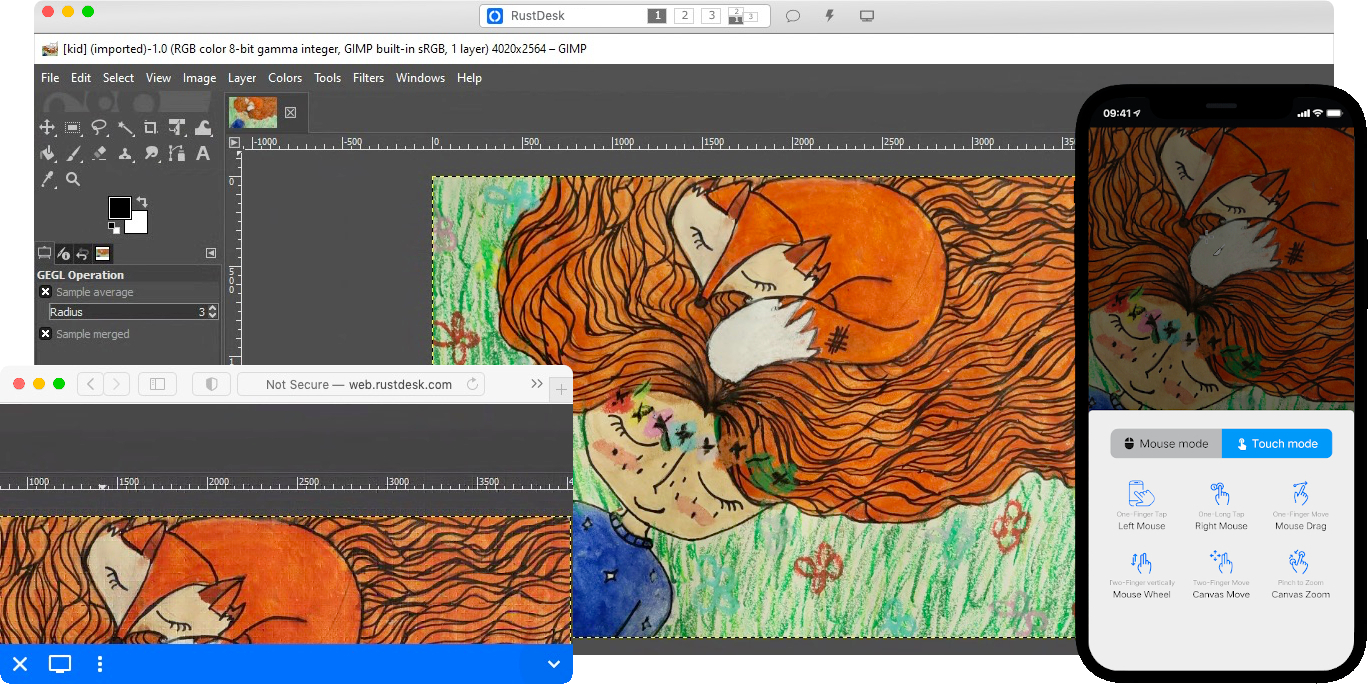
RustDesk welcomes contribution from everyone. See CONTRIBUTING.md for help getting started.

Dependencies
Desktop versions use Flutter or Sciter (deprecated) for GUI. This tutorial is for Sciter only, since it is easier and more friendly to start. Check out our CI for building the Flutter version.
Please download Sciter dynamic library yourself.
Raw Steps to build
-
Prepare your Rust development env and C++ build env
-
Install vcpkg, and set
VCPKG_ROOTenv variable correctly- Windows: vcpkg install libvpx:x64-windows-static libyuv:x64-windows-static opus:x64-windows-static aom:x64-windows-static
- Linux/macOS: vcpkg install libvpx libyuv opus aom
-
run
cargo run
Build
How to Build on Linux
Ubuntu 18 (Debian 10)
sudo apt install -y zip g++ gcc git curl wget nasm yasm libgtk-3-dev clang libxcb-randr0-dev libxdo-dev \
        libxfixes-dev libxcb-shape0-dev libxcb-xfixes0-dev libasound2-dev libpulse-dev cmake make \
        libclang-dev ninja-build libgstreamer1.0-dev libgstreamer-plugins-base1.0-dev
openSUSE Tumbleweed
sudo zypper install gcc-c++ git curl wget nasm yasm gcc gtk3-devel clang libxcb-devel libXfixes-devel cmake alsa-lib-devel gstreamer-devel gstreamer-plugins-base-devel xdotool-devel
Fedora 28 (CentOS 8)
sudo yum -y install gcc-c++ git curl wget nasm yasm gcc gtk3-devel clang libxcb-devel libxdo-devel libXfixes-devel pulseaudio-libs-devel cmake alsa-lib-devel gstreamer1-devel gstreamer1-plugins-base-devel
Arch (Manjaro)
sudo pacman -Syu --needed unzip git cmake gcc curl wget yasm nasm zip make pkg-config clang gtk3 xdotool libxcb libxfixes alsa-lib pipewire
Install vcpkg
git clone https://github.com/microsoft/vcpkg
cd vcpkg
git checkout 2023.04.15
cd ..
vcpkg/bootstrap-vcpkg.sh
export VCPKG_ROOT=$HOME/vcpkg
vcpkg/vcpkg install libvpx libyuv opus aom
Fix libvpx (For Fedora)
cd vcpkg/buildtrees/libvpx/src
cd *
./configure
sed -i 's/CFLAGS+=-I/CFLAGS+=-fPIC -I/g' Makefile
sed -i 's/CXXFLAGS+=-I/CXXFLAGS+=-fPIC -I/g' Makefile
make
cp libvpx.a $HOME/vcpkg/installed/x64-linux/lib/
cd
Build
curl --proto '=https' --tlsv1.2 -sSf https://sh.rustup.rs | sh
source $HOME/.cargo/env
git clone --recurse-submodules https://github.com/rustdesk/rustdesk
cd rustdesk
mkdir -p target/debug
wget https://raw.githubusercontent.com/c-smile/sciter-sdk/master/bin.lnx/x64/libsciter-gtk.so
mv libsciter-gtk.so target/debug
VCPKG_ROOT=$HOME/vcpkg cargo run
How to build with Docker
Begin by cloning the repository and building the Docker container:
git clone https://github.com/rustdesk/rustdesk
cd rustdesk
git submodule update --init --recursive
docker build -t "rustdesk-builder" .
Then, each time you need to build the application, run the following command:
docker run --rm -it -v $PWD:/home/user/rustdesk -v rustdesk-git-cache:/home/user/.cargo/git -v rustdesk-registry-cache:/home/user/.cargo/registry -e PUID="$(id -u)" -e PGID="$(id -g)" rustdesk-builder
Note that the first build may take longer before dependencies are cached, subsequent builds will be faster. Additionally, if you need to specify different arguments to the build command, you may do so at the end of the command in the <OPTIONAL-ARGS> position. For instance, if you wanted to build an optimized release version, you would run the command above followed by --release. The resulting executable will be available in the target folder on your system, and can be run with:
target/debug/rustdesk
Or, if you're running a release executable:
target/release/rustdesk
Please ensure that you run these commands from the root of the RustDesk repository, or the application may not find the required resources. Also note that other cargo subcommands such as install or run are not currently supported via this method as they would install or run the program inside the container instead of the host.
File Structure
- libs/hbb_common: video codec, config, tcp/udp wrapper, and some other utility functions shared with the server
- libs/base: protobuf, fs functions for file transfer, keyboard and platform code used only by this app
- libs/scrap: screen capture
- libs/enigo: platform specific keyboard/mouse control
- libs/clipboard: file copy and paste implementation for Windows, Linux, macOS.
- src/ui: obsolete Sciter UI (deprecated)
- src/server: audio/clipboard/input/video services, and network connections
- src/client.rs: start a peer connection
- src/rendezvous_mediator.rs: Communicate with rustdesk-server, wait for remote direct (TCP hole punching) or relayed connection
- src/platform: platform specific code
- flutter: Flutter code for desktop and mobile